Share article
Shoppable content benefits go beyond a single conversion metric, touching product discovery, trust, and distribution as well as sales.
For marketing and ecommerce teams under pressure to justify content spend, closing the gap between what shoppers see and what they buy has become a practical requirement, not a design preference.
This article breaks down what shoppable content is, where it applies, and how to use and measure it effectively.
What Is Shoppable Content?
Shoppable content is any format where a shopper encounters a product embedded in an image, video, social post, digital catalog, or lookbook and can access product details or move toward a purchase without leaving that content.
The mechanic is simple: it connects product discovery to product information and a commercial action inside the same experience.
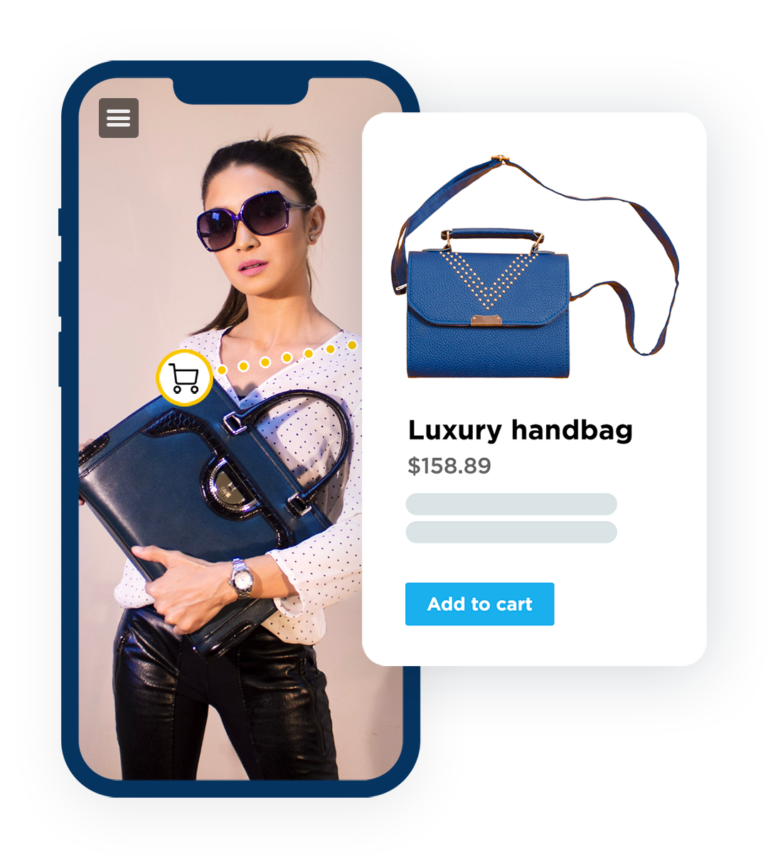
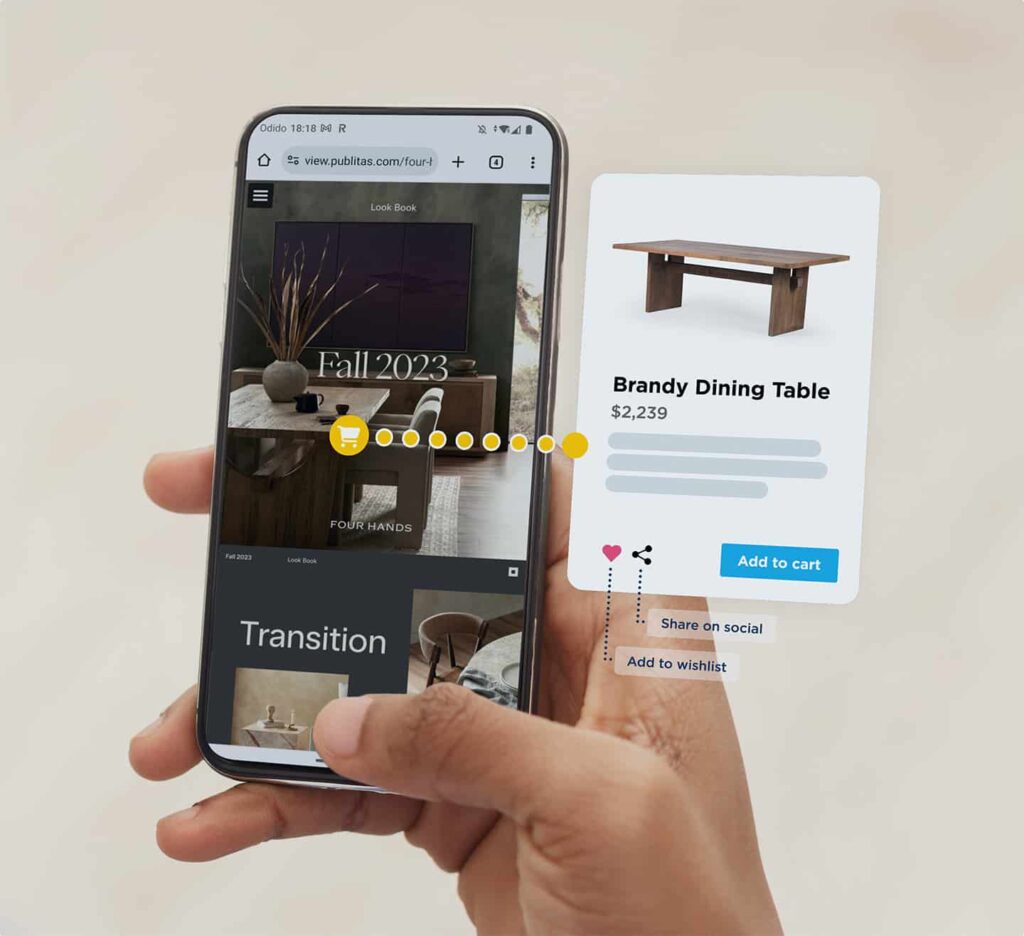
A shopper viewing a styled outfit in a lookbook can tap the jacket to see its price, size options, and stock status. That interaction replaces a search query with a direct link between what the shopper sees and what they can do next.
The format works because it removes a step in the shopper’s path, not because it automatically drives sales on its own.
What Are the Benefits of Shoppable Content?
The benefits of shoppable content extend past conversion. Retailers that adopt shoppable formats see gains in product discovery, trust, engagement, distribution, and measurable commercial outcomes, each tied to a different point in the shopper’s decision path.
Makes Product Discovery More Actionable
Product tags, links, and interactive elements turn passive viewing into active exploration. A shopper who notices a product in a styled scene can access its details immediately, rather than searching for it separately.
- Digital catalogs and lookbooks: Tapping a featured item surfaces price, variants, and stock without leaving the spread.
- Images: Hotspots on a lifestyle photo reveal the individual products in the scene.
- Video: Tagged products let a viewer act on what they’re watching mid-play.
Inspiration and product information usually live in different places online; shoppable formats put both in the same frame.
Shortens the Path From Discovery to Purchase
Fewer steps between discovery and purchase means fewer opportunities for a shopper to lose momentum.
- Fewer page transitions between seeing a product and viewing its details.
- Fewer decision points between interest and the next commercial action.
- Less reliance on search, since the product is already in context.
Checkout friction remains one of the largest drags on ecommerce performance: the average cart abandonment rate sits at 70.22%, based on a meta-analysis of 50 studies by the Baymard Institute, and unexpected costs or unclear next steps are recurring causes.
Shoppable content addresses an earlier stage of that same friction problem, before a shopper ever reaches checkout.
Builds Trust Through Social Proof and UGC
Customer photos, reviews, and creator content give shoppers context a product photo alone cannot provide. Seeing how a product looks or functions in a real setting reduces the uncertainty that keeps shoppers from committing to a purchase.
- Customer photos and video: Show the product in real use, not staged conditions.
- Reviews and ratings: Reduce uncertainty before a shopper commits.
- Creator and influencer content: Adds a familiar, third-party perspective.
- Product demonstrations: Answer functional questions a photo cannot.
According to the Medill Spiegel Research Center at Northwestern University, purchase likelihood for a product with five reviews is 270% greater than for a product with none, and the effect is stronger for higher-priced items.
Creates More Opportunities for Engagement and Conversion
Interactive elements give shoppers more reasons to stay within a piece of content and more paths toward a commercial action.
- Product carousels: Extend time spent exploring a single spread or scene.
- Hotspots: Reveal color, size, or bundle options without a new page load.
- Linked bundles: Give shoppers an additional, related path to purchase.
Engagement and conversion are related but distinct: a shopper exploring multiple products in a catalog is engaged, while a shopper adding one to cart has converted. Design choices should treat them as separate goals.
Extends Commerce Across Customer Touchpoints
A single piece of content can be made actionable across social media, email, editorial pages, digital catalogs, lookbooks, and video, rather than being rebuilt for each channel.
This is one of the more overlooked shoppable content benefits, and the practical foundation of shoppable content marketing: the same shoppable asset follows the shopper across the channels they already use.
- No separate build per channel: One shoppable catalog spread can be shared to email or social directly.
- Consistent product data: Pricing and availability stay accurate everywhere the content appears.
- Lower operational burden: Marketing teams maintain one content and commerce system instead of several.
Connects Content Performance With Commercial Data
Shoppable interactions generate data that ties content directly to commercial signals, closing a measurement gap that static content cannot close on its own. Without shoppable elements, a marketing team can see that a piece of content was viewed, but not whether it influenced a purchase.
- Content-level signals: Clicks, product views, and click-through rate.
- Commercial signals: Add-to-cart activity, conversions, and revenue.
- Attribution signals: Assisted conversions, showing where content influenced a sale it didn’t directly close.
Where Can Brands Use Shoppable Content?
Shoppable content for ecommerce is not limited to any single channel. The format applies anywhere a retailer already publishes visual or narrative content and wants to connect it to a commercial next step.
- Social media and shoppable images: Product tags on posts, stories, and image galleries.
- Video: Embedded product links within product demos or styled video content.
- User-generated content: Customer photos and reviews made clickable within a gallery or feed.
- Email: Shoppable product blocks inside newsletters or promotional sends.
- Digital catalogs and lookbooks: Full publications with product-level interactivity throughout.
- Editorial content and ads: Articles, guides, or paid placements with embedded product access.
The right format depends on where the content already lives and how a retailer’s audience typically encounters it, not on adopting every channel at once.
How to Use Shoppable Content Effectively
The advantages of shoppable content only materialize when execution follows a few core practices. Poor implementation, such as broken product links or cluttered interactive elements, undermines the format’s core value.
- Link only to relevant, in-stock products, not every item visible in the frame.
- Keep product data (pricing, availability, variants) accurate and current.
- Make shoppable elements visually clear without disrupting the content itself.
- Match each CTA to shopper intent rather than defaulting to “buy now” everywhere.
- Optimize every shoppable format for mobile, since most discovery happens there.
- Avoid overloading a single piece of content with too many interactive points.
These practices keep the shopper’s attention on the content while still making the commercial path available whenever they’re ready to act.
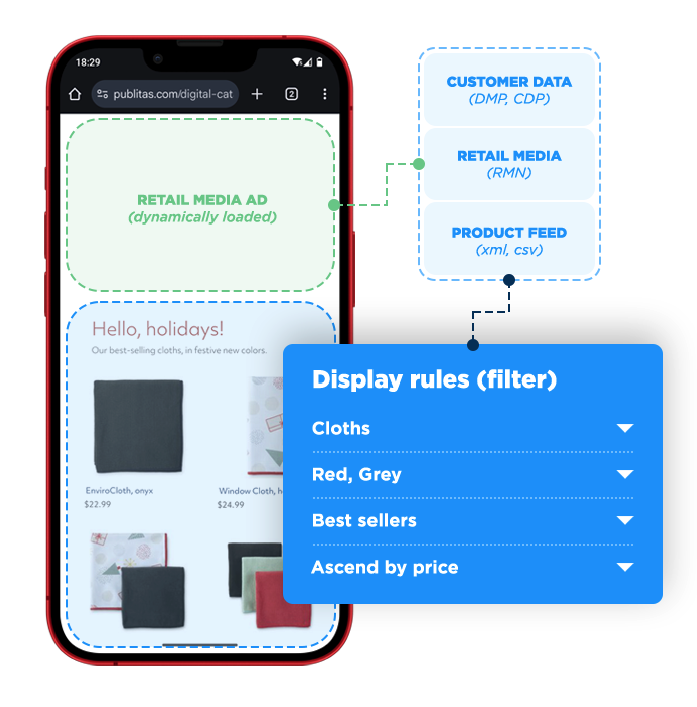
Platforms like Publitas support this through automated product feed syncing and mobile-first templates, which keep pricing and availability accurate across formats without manual updates.
How to Measure Shoppable Content Performance
Measuring shoppable content requires tracking engagement and commercial impact together, not as separate reports. Engagement metrics show whether shoppers are interacting with the content; commercial metrics show whether that interaction is producing revenue.
- Engagement metrics: Engagement rate, product clicks, click-through rate, and product views, showing which content and which products are drawing attention
- Commercial metrics: Add-to-cart activity, conversions, and revenue, showing whether that attention is translating into sales
- Attribution metrics: Assisted conversions, showing where content influenced a sale it didn’t directly close
Retailers already measuring digital catalog performance can apply the same framework to other shoppable formats, since the underlying signals stay consistent across channels.
FAQs: Shoppable Content Benefits
Can Shoppable Content Work Without a Social Media Presence?
Yes, shoppable content is not limited to social platforms. Owned channels such as a retailer’s website, email campaigns, digital catalogs, lookbooks, and editorial content can all carry shoppable elements without any dependence on social distribution.
Does Shoppable Content Work Better for New or Existing Customers?
It supports both, but in different ways. For new customers, shoppable content aids discovery and helps them explore an unfamiliar catalog. For existing customers, it works well for surfacing new products, complementary items, and personalized recommendations based on past behavior.
How Much Product Information Should a Shoppable Content Experience Include?
Enough to support exploration without turning the content into a full product page. A price, key details, and a clear next step are usually sufficient. More complex or considered purchases may warrant additional supporting information before a shopper is ready to act.
What Happens When a Product Featured in Shoppable Content Goes Out of Stock?
Product links and inventory data need to stay synchronized so shoppers are not sent to a dead end. When a featured product goes out of stock, options include swapping in a related product, offering a waitlist, or updating the content until availability returns.
How Often Should Brands Update Shoppable Content?
Update frequency depends on how quickly the underlying products, pricing, promotions, and inventory change. Seasonal or promotional content typically needs frequent updates, while evergreen content can keep delivering shoppable content benefits as long as the product information behind it stays accurate.
Enjoyed this article?
Get the next one straight to your inbox.