
Share article
Calculating ROI from digital catalogs requires more than counting views and clicks. Effective measurement compares revenue and value from catalog interactions against the cost of creating those experiences.
For enterprise retailers trying to prove catalog value to leadership, this guide covers which metrics matter, how to calculate ROI, and how to build a business case.
What ROI Means in Digital Catalog Marketing
Return on investment measures whether a digital catalog generates more value than it costs to create and maintain. For retailers, digital catalog ROI should extend well beyond immediate sales attribution.
Why Measuring ROI Matters
Without ROI measurement, catalogs remain viewed as marketing costs rather than revenue-generating commerce channels. Measuring digital catalog ROI helps you:
- Identify which products, categories, and promotions attract attention before customers reach product detail pages
- Quantify the commercial contribution of catalog content when competing for budget against paid media and CRM
- Create a repeatable framework for evaluating campaign performance across markets, seasons, and promotions
Why Traditional Catalog Measurement Falls Short
Many organizations still evaluate catalogs using metrics that obscure commercial performance:
- Measuring opens and views without understanding downstream purchase behavior
- Ignoring assisted conversions that occur later through ecommerce channels
- Treating catalogs as isolated assets instead of connected commerce experiences
- Missing opportunities to connect engagement data with merchandising decisions
Modern catalog measurement requires a broader view of customer behavior across the full buying journey.
What Should Be Included in Digital Catalog ROI Calculations?
A reliable ROI model requires capturing both the full cost of catalog operations and the full range of value it generates.
Costs to Include
Most retailers underestimate the full cost of catalog operations. Include:
- Design, creative production, and merchandising resources
- Translation, localization, and regional adaptation expenses
- Platform licensing and software subscription fees
- Distribution, campaign promotion, and internal review time
Revenue and Value Metrics to Include
Revenue should not be the only value driver in your model. Consider:
- Revenue generated directly from catalog sessions that convert during the same visit
- Assisted revenue from customers who engage with catalog content before converting through another channel
- Product discovery impact measured through product clicks, category exploration, and PDP visits
- Operational savings from reducing manual content production, localization effort, and publishing time
Common ROI Calculation Mistakes
- Giving all credit to last-click conversions even when catalogs influenced earlier discovery
- Measuring engagement volume without evaluating whether it translates into commercial actions
- Failing to establish baseline metrics before launch, making post-implementation analysis impossible
How to Calculate ROI From Digital Catalogs
Use a consistent framework when calculating ROI from digital catalogs to ensure results are comparable across campaigns and periods.
The Basic ROI Formula
ROI (%) = (Total Value Generated − Total Investment Cost) ÷ Total Investment Cost × 100
Example ROI Calculation
A retailer running seasonal campaigns through a digital catalog:
Annual costs:
- Platform subscription: $8,000
- Content production: $15,000
- Internal resources: $12,000
- Total: $35,000
Annual impact:
- Direct sales: $60,000
- Assisted conversions: $35,000
- Operational savings: $15,000
- Total: $110,000
ROI: ($110,000 − $35,000) ÷ $35,000 × 100 = 214%
This example demonstrates why operational savings belong in any ROI model alongside revenue.
A More Advanced ROI Model for Retailers
Enterprise retailers often require more sophisticated attribution models:
- Multi-touch attribution assigning value across multiple customer interactions rather than only the final conversion
- Customer lifetime value measurement to understand the long-term value of catalog-acquired customers
- Omnichannel attribution frameworks connecting catalog engagement with online and offline purchase behavior
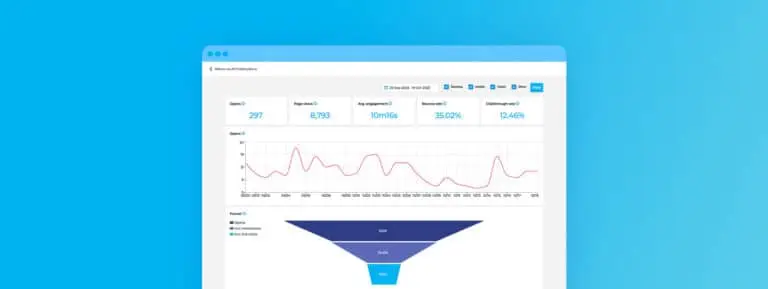
Use your catalog data dashboard to capture the engagement and conversion data these models require.
Which Metrics Matter Most When Measuring Digital Catalog ROI?
Not all digital catalog metrics have equal value. The most useful ones connect engagement directly to commercial outcomes. See Publitas industry benchmarks to compare your performance against sector averages.
Revenue Metrics
- Revenue generated per catalog session
- Assisted revenue contribution across longer buying journeys
- Conversion rate from catalog visitors to purchasers
- Average order value of customers who engage with catalog content vs. those who do not
Engagement Metrics
- Average engagement time indicating depth of content consumption
- Product interaction rate showing whether customers move beyond passive viewing
- Product click-through rate by category and campaign
Customer Journey Metrics
- Product detail page visits originating from catalog interactions
- Assisted conversions occurring days or weeks after initial engagement
Catalog Performance Metrics
- Product click rate by page, category, and campaign
- Category engagement patterns influencing merchandising decisions
- Performance of featured collections compared with standard assortments
The Metrics That Predict ROI Before Revenue Appears
Revenue often lags behind engagement. These leading indicators help predict future digital catalog ROI before conversions appear in reporting.
Product Click Rate
Higher click rates typically signal strong merchandising decisions, relevant assortments, and better alignment between customer demand and product presentation.
Catalog Engagement Time
When combined with product interaction data, engagement time reveals whether customers are actively evaluating products or simply browsing without intent.
Product Detail Page Visits
PDP visits represent one of the strongest indicators of purchase consideration and typically rise before measurable revenue improvements appear in reporting.
Add-to-Cart Actions
Add-to-cart activity is one of the strongest predictors of future revenue. Retailers frequently observe increases in cart activity before conversion rates improve.
Repeat Catalog Visits
Repeat visits typically indicate active product research, ongoing comparison behavior, or seasonal purchase planning, all of which signal stronger purchase intent.
How to Improve ROI From Digital Catalogs
Improving digital catalog marketing ROI requires both better experiences and better measurement.
Improve Product Discoverability
- Surface high-margin products in prominent catalog placements
- Reduce navigation friction by connecting content directly to purchasable products
- Use curated collections to help customers discover complementary products
- Analyze interaction data to identify products receiving attention but failing to convert
Optronics saw a 300% increase in page views after optimizing their catalog navigation and search experience using Publitas.
Personalize Catalog Experiences
According to McKinsey, personalization most often drives 10 to 15 percent revenue lift. For catalogs, personalization means:
- Delivering different assortments to segments based on purchase history and location
- Adapting catalog experiences according to customer lifecycle stage
- Prioritizing loyalty-focused offers for existing customers and discovery-focused content for new audiences
See six digital catalog design tips for how design decisions directly influence the digital catalog metrics that predict ROI.
Drive Traffic Through Multiple Channels
Catalog performance improves when distribution expands. Effective channels include:
- Email campaigns tied to seasonal and promotional events
- Paid media extending catalog reach to new audiences
- Shoppable landing pages that support campaign-specific product promotion
- Social commerce placements shortening the path from discovery to purchase
- Ecommerce homepage placements increasing visibility for strategic campaigns
Continuously Analyze Catalog Analytics
High-performing retailers treat catalog optimization as an ongoing process, not a post-campaign review. Regular analysis helps you:
- Identify high-performing products and categories before the campaign ends
- Detect underperforming content early enough to act within the live campaign window
- Improve merchandising decisions using behavioral data rather than internal assumptions
- Increase future ROI through continuous iteration based on real engagement patterns
Building a Business Case for Digital Catalog Software
Many retailers eventually need executive approval for catalog technology investments. Focus on measurable outcomes, not platform features.
Questions Stakeholders Typically Ask
- How much incremental revenue can this generate beyond existing channels?
- Which operational costs can realistically be reduced or eliminated?
- What evidence exists that customers interact with and purchase through these experiences?
Example Business Case Framework
- Current operational challenges and inefficiencies with supporting data
- Quantified costs of maintaining existing workflows
- Expected commercial impact across engagement, conversion, and revenue
- Estimated ROI scenarios based on conservative assumptions
KPIs to Include in Executive Reporting
Executives respond to metrics that connect directly to revenue and efficiency. Prioritize:
- Revenue influenced by catalog engagement, not just last-click attribution
- Conversion rates associated with catalog-sourced traffic
- Average order value improvement for catalog-engaged customers
- Assisted conversion contribution showing catalog’s role across the buying journey
- Content production efficiency: time saved and campaign cycles reduced
Publitas helps enterprise retailers connect catalog engagement data, product interactions, and conversion journeys into a single measurement framework, making it significantly easier to build and defend a digital catalog ROI business case.
Conclusion
Calculating ROI from digital catalogs means looking beyond views and clicks.
Combine revenue attribution, engagement analysis, and operational efficiencies. Track the right digital catalog metrics to measure digital catalog performance and prove digital catalog marketing ROI.
Book a demo with Publitas to see this in practice.
FAQs
How Do You Calculate ROI From a Digital Catalog?
Calculate ROI by subtracting total catalog costs from total value generated, then dividing by total costs. Include both direct revenue and assisted business value such as operational savings and assisted conversions, not just last-click sales.
Which Metrics Are Most Important for Measuring Digital Catalog Performance?
The most important digital catalog metrics include revenue attribution, product click rate, engagement time, product detail page visits, add-to-cart actions, and assisted conversions. Leading indicators typically appear before revenue improvements show in reporting.
Can Digital Catalogs Influence Sales Even if They Are Not the Final Conversion Touchpoint?
Yes. Digital catalogs frequently influence product discovery and purchase consideration before customers convert through another channel. Assisted conversion analysis is essential for capturing the full commercial contribution of catalog content.
How Does Digital Catalog ROI Compare to Print Catalog ROI?
Digital catalogs deliver stronger measurement capabilities because engagement, product interactions, and conversion pathways can all be tracked directly. Print catalogs cannot attribute assisted conversions, measure individual product performance, or connect engagement to downstream purchases.
How Can Retailers Improve the ROI of Their Digital Catalogs?
Retailers improve ROI through better product discoverability, personalization, multi-channel distribution, and continuous performance optimization using behavioral engagement data rather than assumptions.
Enjoyed this article?
Get the next one straight to your inbox.