How METRO Germany Piloted a Dynamic Catalog to Drive Logins and Product Engagement
As part of its broader digital transformation, METRO is actively exploring new ways to modernize how it delivers product content to customers. One key focus area: moving beyond static PDFs toward dynamic, data-driven catalog experiences.
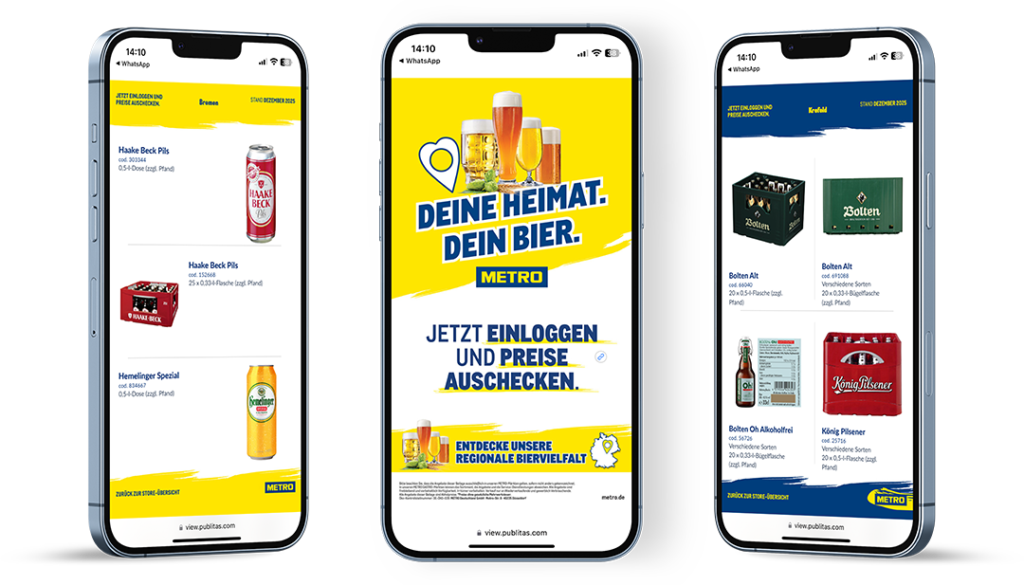
In late 2025, METRO Germany launched a dynamic beer catalog pilot using Publitas. The goal was to test a more flexible, scalable approach to catalog creation – while introducing personalized, store-specific pricing that reflects how B2B customers actually shop.
The Objective: Move Toward Personalization, Automation, and Scalability
For METRO, traditional catalog production comes with clear limitations: static content, manual processes, and limited flexibility across markets.
The dynamic catalog pilot aimed to address these challenges by introducing:
- Store-specific pricing, visible after login
- Automated updates via product feeds
- Reduced production effort
- A scalable model for future catalogs and markets
Rather than optimizing a single campaign, the goal was to explore a new operating model for catalog creation, one that could eventually replace static PDFs.
The Challenge: Delivering Relevant Pricing in a Complex B2B Environment
One of the core requirements of the project was the ability to show different pricing depending on the user and store context.
This introduced both technical and experience challenges:
- Pricing could only be displayed after user login
- Content needed to dynamically update based on product feed changes
- The catalog experience had to remain fast and intuitive, despite increased complexity
At the same time, METRO needed a solution that would support future scalability across countries and categories.
The Solution: A Custom-Built Dynamic Catalog with Login-Based Pricing
To support METRO’s requirements, Publitas developed a custom dynamic setup tailored to B2B use cases.
Key capabilities included:
- Login-based pricing logic, ensuring users see relevant store-specific prices
- Dynamic product feed integration, enabling automatic updates
- Custom themes, allowing flexibility in visual presentation
- Scalable architecture, supporting future rollout across catalogs and regions
This setup allowed METRO to move beyond static content and toward a more responsive, data-driven catalog experience.
Go-Live: Launching the Dynamic Beer Catalog
After initial testing in Italy earlier in 2025, METRO Germany rolled out its dynamic beer catalog on December 1st, 2025, following a development phase in October and November.
The catalog served as a pilot use case, designed to validate both technical feasibility and user engagement before expanding the approach further.
Measuring Success: Focus on Logins and Purchase-Driving Interactions
Given the nature of the project, METRO focused on engagement metrics that reflect purchase intent and user activation.
- Number of logins
- Product clicks
- Interactions with banners and promotional elements
These were grouped under “purchase-driving events”, capturing how users engage with the catalog and move toward buying decisions.
Results: Increased Engagement and Positive Early Outcomes
The pilot delivered encouraging early results.
- Increase in logins, indicating stronger user activation
- Growth in product interactions, including clicks on products and promotional elements
- Positive impact on sales, as reported by the German team
While deeper analysis is ongoing, the overall outcome is considered a success internally.
Operational Impact: Faster Iteration and Reduced Manual Work
Beyond performance metrics, the dynamic catalog also introduced clear operational benefits:
- Less time spent on manual catalog production
- Ability to update content automatically via product feeds
- Greater flexibility for local teams
This supports METRO’s broader goal of enabling countries to take a more hands-on role in catalog creation, while maintaining consistency and efficiency.
Collaboration and Execution: Fast Development and Strong Support
From METRO’s perspective, the collaboration with Publitas was a key factor in the project’s success.
- Quick response times
- Hands-on support during technical challenges
- Close collaboration during development
The team highlighted the speed and responsiveness as particularly valuable during the build phase.
Looking Ahead: Scaling Dynamic Catalogs Across Markets
Following the success of the pilot, METRO is now looking to expand the use of dynamic catalogs:
- Rolling out to additional product categories
- Expanding to other countries
- Exploring store ID–based product personalization
- Evaluating adaptive content and further automation
The long-term ambition is clear: move away from static PDFs and toward a fully dynamic, scalable catalog model.
Conclusion: A First Step Toward Fully Dynamic Catalogs
METRO Germany’s dynamic catalog pilot marks an important step in the evolution of digital catalogs within B2B retail.
By introducing login-based pricing, automated updates, and a scalable framework, METRO has demonstrated how catalogs can become more relevant, efficient, and aligned with modern customer expectations.
While still in its early stages, the project provides a strong foundation for future expansion, positioning METRO as a frontrunner in moving from static publications to dynamic, data-driven catalog experiences.