Product discovery has become harder as brands publish across more channels and formats, while shoppers spend less time evaluating detailed specifications early in their journey.
Visual context now plays a larger role in how people form preferences and decide what to explore further.
As a result, formats that prioritize inspiration and clarity over exhaustive detail have become more important in guiding early-stage discovery.
This shift raises a common question for modern retail teams: what is a lookbook, and how does it differ from traditional catalogs or standard ecommerce pages?
This article explains the benefits of a lookbook, where they fit within a broader digital content strategy, and how they support product discovery in practice.
What Is a Lookbook?
A lookbook is a curated visual publication used by brands to present selected products through imagery, layout, and context rather than exhaustive listings.
Instead of attempting to show an entire assortment, it focuses on how products relate to one another, how they are used, and how they fit within a broader theme or moment.
This approach helps audiences understand style, intent, and relevance before they are ready to compare specifications or prices.
By guiding attention and shaping perception, lookbooks support product discovery and inspiration rather than direct transaction, which has become increasingly important as brands operate across more digital channels and touchpoints.
The Evolution of Lookbooks: From Print to Interactive Digital Experiences
The role of the lookbook has expanded as shopping behavior and media consumption have changed. What began as a presentation-focused format has evolved into a tool that supports discovery, engagement, and measurement.
Early lookbooks were printed publications shared with buyers, press, or in-store audiences. Their value came from strong visual coherence and storytelling rather than reach or scale.
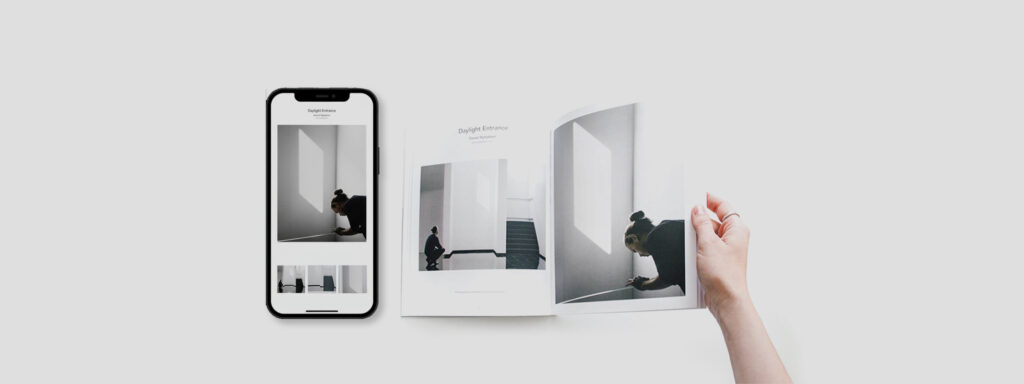
As brands moved online, these print layouts were often replicated as PDFs. While this increased distribution, it limited interactivity and offered little insight into how audiences engaged with the content.
Today, digital lookbooks are built for exploration and performance. They can include links, rich media, and analytics that show how people browse, where attention concentrates, and which products generate interest.
This evolution reflects a shift from static visual presentation to a format designed to support product discovery across modern digital channels.
Benefits of a Lookbook for Brands and Retailers
The way people discover products has changed, and brands that rely on traditional listing-based formats often struggle to hold attention early in the buying journey.
Lookbooks address this shift by aligning with how audiences naturally browse, compare, and form preferences through visual cues.
Understanding the benefits of this format helps brands decide when a lookbook is the most effective tool for driving discovery and engagement.
Clearer product positioning through visual context
Visual storytelling allows brands to control how products are perceived before shoppers begin comparing options.
By showing products in realistic or aspirational settings, lookbooks reduce ambiguity around use, fit, and style, which helps audiences understand value more quickly.
Consistent imagery strengthens brand recognition and ensures that positioning is communicated visually rather than explained repeatedly across channels.
This leads to stronger recall, clearer differentiation, and more consistent brand perception in markets where products are often visually similar.
Faster product discovery and browsing
Lookbooks help audiences find relevance faster by removing unnecessary choices early in the journey. Presenting a curated selection instead of a full assortment shortens the time it takes for shoppers to understand what matters within a collection. This effect becomes stronger when curation is informed by behavioral signals rather than fixed assumptions.
Personalized lookbooks can adapt product selection and sequencing based on historic engagement, such as products viewed on-site, categories explored, in-store interactions, or previous purchases.
When dynamic templates surface products aligned to demonstrated interest, shoppers spend less time filtering and more time evaluating. This reduces friction during early discovery, increases perceived relevance, and encourages deeper engagement with fewer, more meaningful product interactions.
Rather than forcing audiences to navigate broad assortments, personalized lookbooks guide attention toward items that already align with intent. The result is faster orientation, lower drop-off during exploration, and higher-quality engagement that supports downstream conversion.
Higher engagement through layouts
Well-structured layouts extend engagement by guiding attention deliberately rather than relying on novelty.
Visual hierarchy, pacing, and variation reduce cognitive load, helping audiences progress naturally through content instead of abandoning it early.
In mobile-first environments, where attention is fragmented, this clarity is critical to sustaining exploration beyond the first few screens.
Compared to static or list-based formats, lookbooks encourage deeper sequential consumption rather than shallow scanning.
Increased conversion potential
Lookbooks influence conversion indirectly by clarifying relevance before evaluation begins.
Contextual presentation reduces uncertainty around use, fit, and compatibility, helping shoppers self-qualify products earlier in the journey.
When clear pathways to product pages are introduced at moments of intent, interest can progress without forcing premature decisions.
This positions lookbooks as assisted-conversion drivers that strengthen downstream performance, even when purchase occurs later or on a different channel.
Better alignment across marketing, merchandising, and sales teams
Lookbooks provide teams with a shared visual reference that reduces misalignment during execution.
When marketing, merchandising, and sales work from the same narrative, there is less reinterpretation and fewer inconsistencies across channels.
This improves efficiency, shortens production cycles, and reduces rework.
Over time, this alignment helps organizations scale content output while maintaining clarity and consistency in how products are presented.
Together, these benefits show why lookbooks remain effective as discovery formats in environments where attention is limited and choice is abundant. But how do you make a lookbook that actually delivers this level of value?
Key Elements Every Lookbook Should Include
A lookbook only delivers value when its structure supports discovery rather than distraction. Understanding the essential elements helps teams translate the idea of a lookbook into a format that works consistently across audiences, channels, and devices.
High-quality visual assets
Visual quality directly affects how credible and trustworthy a lookbook feels.
Consistent lighting, composition, and styling prevent visual noise and help viewers focus on the products rather than the presentation. Clear detail allows audiences to understand texture, scale, and form without relying on specifications, which is especially important early in the buying journey.
When visuals are produced with flexibility in mind, they can also be reused across email, social, and paid channels without losing impact. Strong visual assets form the foundation for all other lookbook benefits.
A theme or narrative that ties the collection together
A lookbook needs a unifying idea to feel intentional rather than decorative.
A clear theme, whether seasonal, functional, or conceptual, gives structure to the collection and explains why certain products appear together. Narrative logic helps viewers follow the flow of content and understand relationships between items without explanation.
When a lookbook is framed around a memorable idea, it becomes easier to recall and easier to reuse as a reference point across campaigns. This narrative coherence turns a set of images into a purposeful discovery experience.
Clear product information where relevant
Even in inspiration-led formats, clarity plays a critical role.
Lookbooks work best when they include just enough product information to support interest without interrupting flow. Consistent naming and labeling reduce friction when viewers are keen to explore further, while contextual placement ensures information appears at moments of intent rather than all at once.
This balance allows the lookbook to remain visually led while still supporting progression toward evaluation or action.
Lifestyle imagery that helps shoppers visualize use cases
Lifestyle imagery helps bridge the gap between inspiration and practical understanding.
Showing products in realistic environments answers unspoken questions about fit, use, and relevance without relying on explanation. Aspirational cues help audiences imagine outcomes, while believable scenarios prevent the content from feeling detached from real-world use.
This type of imagery is especially effective early in the journey, when shoppers are forming preferences rather than making decisions.
Shoppable tags, links, or interactive elements
Interactivity allows a lookbook to move beyond inspiration without disrupting its purpose.
When links or tags are integrated thoughtfully, they create direct pathways from interest to exploration while preserving visual flow. These elements also make engagement measurable, providing insight into which products attract attention and how audiences move through the content.
Used selectively, interactivity extends the advantages of using lookbooks into performance analysis and optimization rather than turning the format into a transactional grid.
Taken together, these elements determine whether a lookbook simply looks good or actually supports discovery and engagement. When visuals, narrative, information, and interactivity are aligned, the format becomes easier to browse, easier to understand, and easier to act on.
How Brands Measure Lookbook Performance
Measuring lookbook performance requires looking beyond surface-level engagement and focusing on how discovery behavior evolves through interaction. Digital lookbooks make this possible by capturing progression, not just presence.
- Engagement and attention: Metrics such as scroll depth, time spent, and interaction density indicate whether audiences are consuming content sequentially or abandoning it early.
- Navigation and product interest: Page flow, product link clicks, and revisit behavior reveal how viewers move from inspiration toward evaluation, and which products generate sustained interest rather than one-off curiosity.
- Assisted conversion impact: Repeat visits, delayed conversions, and cross-channel attribution help explain how lookbooks influence purchasing decisions that do not happen immediately or within a single session.
- Direct conversion and sales (where ecommerce integrations are in place): When lookbooks are connected to ecommerce systems, teams can measure direct outcomes such as add-to-cart activity, completed purchases, and revenue generated from lookbook interactions. This allows brands to distinguish between discovery-led influence and transactions that occur within the same session.
- Content optimization: Performance patterns across layouts, narratives, and product groupings allow teams to refine future lookbooks based on observed behavior rather than assumptions.
Together, these signals position lookbooks as measurable discovery assets that inform merchandising, content planning, and experience design over time.
How to Create a Lookbook
Creating a lookbook starts with clarity, not complexity. The goal is to guide discovery through visuals and structure, making it easy for audiences to explore without feeling overwhelmed.
- Define the purpose and audience: Be clear on who the lookbook is for and what it needs to support, such as discovery, launch awareness, or sales enablement.
- Choose a clear theme: Anchor the content around a single idea or use case so the collection feels intentional and easy to follow.
- Curate the product selection: Select products that belong together and reinforce the narrative rather than showing a full assortment.
- Design for visual flow: Use layout, spacing, and hierarchy to guide attention naturally, especially across mobile screens.
- Add light interactivity where relevant: Include links or tags only where they help move interest forward without interrupting the experience.
A strong lookbook balances inspiration with restraint. When purpose, narrative, and structure align, the format becomes easy to browse, easy to understand, and easy to reuse across channels.
Digital Lookbooks vs. Static Lookbooks: Which One Should You Choose?
The difference between static and digital lookbooks comes down to flexibility and insight. When content is fixed and short-lived, a static format may be sufficient. When content needs to evolve, perform across channels, or be measured, a digital format becomes more practical.
| Aspect | Static Lookbooks | Digital Lookbooks |
| Best suited for | Fixed or one-off collections | Ongoing or repeat campaigns |
| Ability to update | Cannot be changed after publishing | Can be edited and reused |
| Interactivity | None or minimal | Supports links and interactive elements |
| Performance visibility | No engagement insight | Tracks engagement and product interest |
| Channel use | Limited distribution | Works across email, social, paid, and web |
The distinction becomes more pronounced as organizations scale content output. Static lookbooks work when control and finality matter more than learning. Digital lookbooks are better suited to environments where assortments change frequently, campaigns overlap, and understanding audience behavior informs future decisions.
Real-World Use Cases for Lookbooks Across Industries
Lookbooks are used across industries because the format adapts easily to different discovery needs and buying contexts.
- Fashion and apparel: Used to introduce seasonal collections, show complete looks, and frame trends visually.
- Furniture and home decor: Helps shoppers visualize products in real spaces and understand scale and combinations.
- Wholesale and B2B: Provides a clear way to present assortments and support sales conversations without exhaustive listings.
- Product launches and seasonal drops: Allows brands to control focus and introduce new products without distraction.
- Beauty and lifestyle: Shows products in routines or use sequences, supporting education and emotional connection.
These examples show how lookbooks function as flexible discovery tools across different industries.
Turn Lookbooks Into Measurable Discovery Experiences
Lookbooks deliver their greatest value when inspiration is connected to visibility and iteration. Without insight into how audiences browse, engage, and progress, even well-designed lookbooks remain static presentations rather than inputs into improvement.
Digital lookbooks make discovery measurable by revealing which narratives hold attention, which products attract sustained interest, and how exploration translates into downstream action over time. This visibility allows teams to refine structure, sequencing, and product emphasis based on observed behavior rather than intuition.
Publitas enables brands to publish digital lookbooks that combine visual storytelling, interaction, and performance measurement within a single environment. This allows lookbooks to function not only as inspiration tools, but as ongoing contributors to merchandising, marketing, and content strategy decisions.
Explore how Publitas supports discovery-led lookbooks by booking a demo.
Frequently Asked Questions
What is a lookbook used for?
The main purpose of a lookbook is to support product discovery through curated visual storytelling. Rather than listing every product, it presents selected items in context so viewers can explore styles, combinations, or use cases. This approach helps audiences form preferences before entering detailed comparison or purchase stages.
What’s the difference between a catalog and a lookbook?
A catalog focuses on completeness and specification, while a lookbook focuses on inspiration and curation. A catalog aims to show everything available, often with pricing and technical details. A lookbook highlights selected products to guide discovery, using imagery and narrative to shape perception and interest.
Are lookbooks still relevant in the digital era?
Yes, lookbooks remain relevant because visual discovery plays a growing role in how people browse online. Digital formats expand their usefulness by adding interactivity, measurement, and multi-channel distribution.
What industries benefit most from using lookbooks?
Industries that rely on visual context benefit most, including fashion, home decor, beauty, lifestyle, and design-led B2B sectors. Any category where products are better understood together rather than individually can benefit from a lookbook.
How long should a lookbook be?
There is no fixed length for a lookbook. Effective lookbooks are long enough to communicate a clear narrative but short enough to maintain focus. Digital formats allow flexibility, enabling brands to adjust length based on audience behavior and engagement data.