Share article
Content personalization is now a core expectation in retail, with 71% of consumers expecting tailored experiences and 76% feeling frustrated when brands fail to deliver them. For retailers, irrelevant messaging can lead to lost engagement, lower repeat purchases, and reduced loyalty.
This article explains the mechanics behind personalized content marketing, where it creates the most impact across retail channels, and how to apply it practically. It draws on insights from the content personalization infographic originally published on this page, updated with current data and a more granular look at execution.
What Content Personalization Actually Means, and Why It Drives Revenue
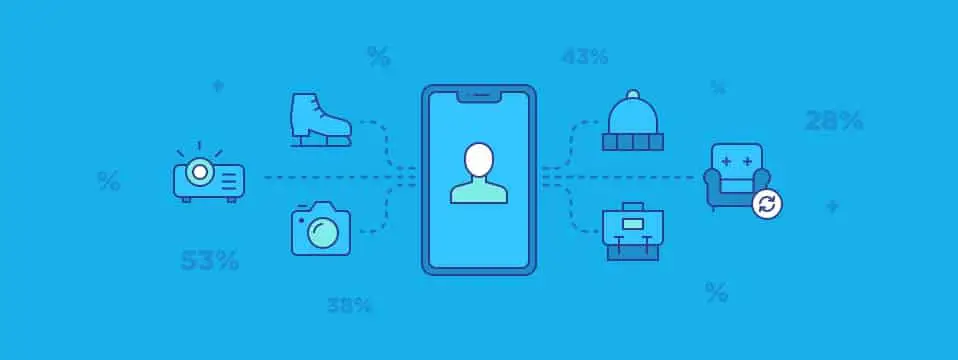
Content personalization is the practice of adapting what a user sees based on who they are and how they behave. That adaptation can be simple (showing returning visitors recently viewed products) or sophisticated (dynamically adjusting entire page layouts, product rankings, and messaging in real time based on session behavior, purchase history, and predictive modeling).
The revenue case is well established. McKinsey research shows that personalization can reduce customer acquisition costs by up to 50%, lift revenue by 5% to 15%, and increase marketing ROI by 10% to 30%. Fast-growing companies derive 40% more of their revenue from personalization than slower-growing peers. The gap between brands that treat personalized content marketing as a core capability and those that treat it as a campaign add-on is measurable and widening.
What makes content personalization effective is not the technology itself but the alignment between the data you have, the content you serve, and the moment in the customer journey when you serve it. Getting any one of those three wrong reduces the return significantly.
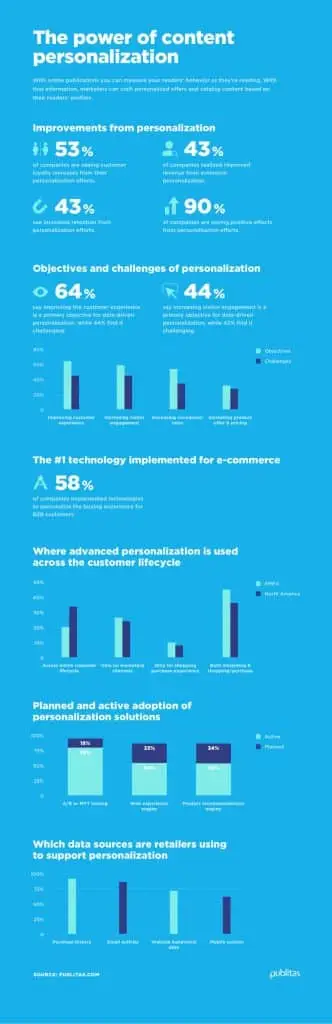
Key Takeaways From the Content Personalization Infographic
What Customers Expect From Personalization
Shoppers do not want generic experiences. They expect brands to remember them, anticipate what they are looking for, and make discovery easier. The most commonly expected personalization signals are product recommendations based on past browsing, communications that reflect previous purchases, and onsite layouts that surface relevant categories rather than defaulting to a one-size-fits-all homepage.
These expectations are not limited to large platforms. Shoppers apply the same standard across brand sites, email, and even digital publications. 49% of consumers say they are likely to become repeat buyers after a personalized experience, which means the expectation is also a loyalty driver when met consistently.
Where Brands Typically Fall Short
The most common execution gap is the confidence-reality mismatch. 67% of retailers believe they are delivering strong personalization, but only 46% of consumers agree. Brands are measuring personalization by the tools they have deployed, not by the experiences their customers are actually receiving.
Other frequent shortfalls include applying personalization to only one channel (usually email) while leaving the onsite experience generic; using demographic segments instead of behavioral signals; and investing in recommendation engines without building the content infrastructure to support varied outputs.
What High-Performing Teams Do Differently
Teams that consistently outperform on personalization share a few operational characteristics. They build a unified view of customer data across channels rather than working from siloed datasets. They apply personalization logic at the discovery stage, not just at the cart or checkout. And they treat personalization as a continuous iteration process rather than a configuration task done once at platform setup.
Why Personalization Works
It Reduces Cognitive Load
Every time a shopper encounters a page full of products that are not relevant to them, they have to do the work of filtering. That cognitive effort is friction, and friction reduces conversion. When ecommerce personalization removes irrelevant options from the visible surface, it makes the shopping experience feel faster and more intuitive, even if the underlying catalog is the same size.
It Matches Intent in Real Time
Shopper intent shifts throughout a session. Someone who arrived via a search for summer dresses has different needs than someone who came back to complete a previously abandoned cart. Real-time behavioral targeting allows brands to respond to those shifts within the session, not just between sessions. The result is a site that feels attentive rather than static.
It Shortens the Path to Purchase
The fewer steps between a shopper arriving and finding something they want to buy, the higher the conversion probability. 59% of consumers say they find it easier to shop on websites that surface personalized recommendations. That ease translates directly into revenue. When a shopper reaches a product they want within two or three clicks rather than navigating through multiple filter layers, the drop-off rate at each step is lower.
Where Personalization Has the Most Impact in Retail
Email and CRM (Expected)
Email remains the channel with the most mature personalized content marketing infrastructure. Segmented campaigns, behavioral triggers, and personalized product blocks are standard practice for most retail brands. The performance differential between personalized and non-personalized email is large enough that this channel now functions as a baseline expectation rather than a competitive advantage. The opportunity is in pushing beyond basic segmentation toward real-time behavioral triggers and lifecycle-aware messaging.
Paid Media (Optimized Reach)
Paid media has become a primary delivery mechanism for behavioral targeting at scale. Dynamic product ads, audience retargeting, and look-alike modeling allow brands to surface relevant products to the right users across search and social. The challenge is that as third-party data becomes less available, paid personalization increasingly depends on the quality and freshness of first-party data fed from owned channels.
Onsite Experience (Conversion Layer)
The onsite experience is where ecommerce personalization has the largest direct impact on conversion. Personalized homepages, category page product rankings, search result ordering, and recommendation modules all operate at the point where intent meets inventory. This is the highest-leverage layer because it affects every session regardless of the acquisition channel. Yet it is also the layer where the confidence-reality gap identified above is most pronounced.
Digital Catalogs (Undervalued Opportunity)
Digital catalogs are an underutilized surface for retail personalization strategy. Most brands treat them as static publications, the same content served to every reader. But personalized catalogs sessions generate rich behavioral data, which pages held attention, which products were clicked, how long was spent on specific spreads. That data is directly usable for downstream personalization in email, retargeting, and onsite merchandising.
Retailers using platforms like Publitas can operationalize this by creating digital-first, shoppable catalogs that generate rich behavioral signals. When connected with personalization platforms such as Bloomreach, that catalog engagement data can help power more relevant onsite experiences, recommendations, and downstream campaign personalization.
How to Apply Personalization in Digital Catalogs
Use Behavioral Data to Adjust Product Visibility
Product visibility within a catalog does not have to be fixed. Brands with behavioral data can prioritize items that align with a reader’s demonstrated category preferences, surfacing the most relevant products early in the publication rather than following a standard editorial sequence. This does not require a full personalization platform; it can start with segment-level customization based on acquisition source, CRM tags, or prior purchase history.
Add Interactive Layers to Static Content
Even without full dynamic content capabilities, adding interactive layers to a catalog increases engagement and data collection simultaneously. Shoppable product hotspots, embedded video, and click-to-expand product detail panels give readers more to interact with and give brands more signal about what is capturing attention. That signal feeds directly into smarter personalization decisions downstream.
Personalize Entry Points, Not Just Content
Entry-point personalization means directing different audience segments into different catalog sections based on what is most relevant to them. A reader who previously engaged with outerwear gets linked to a landing page that opens at the outerwear section. A first-time visitor coming from a seasonal campaign lands on the spread that reflects that campaign context. The catalog itself may not change, but the starting experience is tailored to reduce time-to-relevance.
Track Engagement Signals and Iterate
A digital catalog session produces data that a static PDF does not, including page-level time on content, product click rates, scroll depth, and exit points. Treating that data as a feedback loop rather than a vanity metric is what separates retail personalization strategy that improves over time from one that plateaus. Regular review of catalog engagement data should inform both content decisions and downstream personalization logic.
What Results to Expect From Personalization
The performance impact of content personalization varies depending on implementation maturity and the channel where it is applied. At the channel level, personalized product recommendations drive 25% to 35% of ecommerce revenue for retailers who have built recommendation infrastructure across their onsite experience. At the campaign level, segmented and targeted campaigns can increase conversion rates by up to 50% compared to untargeted equivalents.
For brands earlier in their personalization maturity curve, the more relevant benchmarks are incremental. A 10% to 15% lift in revenue from initial personalization rollout, improvement in repeat purchase rates as CRM personalization matures, and session quality improvements as onsite recommendations become more accurate over time. These gains compound because each improvement generates better behavioral data, which feeds more accurate personalization in subsequent cycles.
Common Personalization Mistakes
Personalized content marketing efforts frequently underperform because of a handful of consistent execution errors.
- Relying on demographic segments instead of behavioral signals. Age and location tell you less about purchase intent than browsing history and product interaction data.
- Personalizing only one channel while leaving others generic. A shopper who receives a highly relevant email and then lands on a generic homepage experiences a jarring discontinuity that undermines the effect of the email.
- Treating personalization as a setup task rather than an ongoing process. Algorithms trained on historical data drift over time as customer preferences evolve. Regular retraining and content refreshes are necessary to maintain performance.
- Measuring personalization success by click-through rate alone without tracking downstream impact on AOV, repeat purchase rate, and lifetime value.
- Deploying recommendation modules without ensuring the underlying content is varied enough to generate meaningfully different outputs for different segments.
Getting Started Without Overhauling Your Stack
A common barrier to ecommerce personalization is the assumption that effective implementation requires a comprehensive platform overhaul. In practice, meaningful personalization improvements are achievable with the tools most retail teams already have access to.
Start with CRM segmentation. Most email platforms support behavioral segmentation based on purchase history and engagement data. Building two or three high-signal segments and serving them different product blocks is a low-effort first step that generates measurable lift and produces data that informs the next iteration.
On the onsite side, most ecommerce platforms include basic recommendation module capabilities. Configuring those modules with category-affinity logic rather than global bestsellers is a straightforward improvement that does not require new technology.
For digital catalog publishers, Publitas supports shoppable catalog creation with embedded product data and engagement tracking, giving retail teams the behavioral signals they need to feed personalization logic across other channels.
Conclusion
A structured approach to content personalization shifts retail from broad messaging to precise, behavior-driven experiences. When retailers align data, content, and delivery timing, they reduce friction in product discovery and improve conversion pathways. The operational impact is equally significant for teams to move faster, rely less on manual segmentation, and continuously optimize using real engagement signals. Platforms that support interactive, data-informed catalogs make this scalable without increasing complexity. Ultimately, content personalization works because it aligns shopper intent with relevant product exposure, turning browsing into measurable commercial outcomes.
FAQs
What is content personalization in ecommerce?
Content personalization in ecommerce delivers tailored experiences, product recommendations, and messaging based on shopper behavior, preferences, and purchase history. Using first-party data, retailers increase relevance, improve engagement, and drive higher conversions across websites, emails, and digital catalogs.
How does personalization improve conversion rates?
Personalization improves conversion rates by showing shoppers relevant products and content faster. It reduces friction, enhances product discovery, increases add-to-cart actions, and encourages repeat purchases through more tailored shopping experiences.
What data is needed to personalize content effectively?
Effective content personalization uses behavioral, transactional, and CRM data, including browsing activity, purchase history, customer preferences, and engagement patterns. First-party behavioral data is often the most valuable and privacy-friendly starting point.
Can digital catalogs be personalized like websites or emails?
Yes, digital catalogs can be highly personalized, often using customer data to tailor experiences similar to websites and emails. They shift from static formats to dynamic tools that adapt content based on browsing history, behavior, or specific audience segments.
What are the biggest challenges in implementing personalization?
Common retail personalization challenges include poor data quality, disconnected systems, limited content variety, and aligning marketing, merchandising, and technology teams. Successful personalization requires both strong data infrastructure and relevant content.
Enjoyed this article?
Get the next one straight to your inbox.