
Share article
The holiday retail marketing strategies that drive measurable ecommerce conversions in 2026 are the ones built around extended shopping windows, mobile-first behavior, and intent-based segmentation rather than a single Black Friday push.
Retailers that plan multi-phase campaigns, replace static creative with interactive shopping experiences, and optimize for real-time signals consistently outperform those running last year’s playbook. Holiday ecommerce marketing now requires earlier planning as shoppers research, compare, and buy across longer digital journeys.
Research shows U.S. consumers spent a record $257.8 billion online during the 2025 holiday season, with 56.4% of transactions completed on smartphones. This guide walks through seven holiday retail campaigns strategies that align directly to how shoppers now research, compare, and buy.
Why holiday retail marketing requires a different strategy
Holiday shopping behavior no longer fits a tidy Cyber Week window. Reports suggest 42% of customers begin holiday shopping before Thanksgiving while 31% continue purchasing from Cyber Monday through New Year’s. The buying window now stretches across nearly three months, with spending spread across multiple cultural moments rather than concentrated on two days.
Shoppers are distributing spending across longer timelines and rewarding brands that maintain visibility throughout the season. Traditional seasonal retail marketing playbooks underperform because they were built for a compressed shopping calendar that no longer reflects how consumers buy today.
7 holiday retail marketing strategies that drive ecommerce conversions
These seven strategies translate the behavioral shifts above into specific moves you can execute. Each one targets a different point in the path to purchase.
1. Launch campaigns earlier to capture seasonal discovery intent
The lead-up phase is where category consideration happens. Shoppers who add products to wishlists in early November are the same ones who convert during peak sale days, so awareness investment in October directly compounds Cyber Week return. Structure holiday ecommerce marketing calendars into three phases such as lead-up for awareness, peak for high-intent conversion, and lead-out for last-minute buyers. Each needs its own creative, offer logic, and budget allocation.
Front-load awareness campaigns across CTV, social, and discovery placements before competition for ad inventory peaks. Hold back the most aggressive value-driven offers for the late-December sprint, when nearly half of budget-conscious shoppers complete their purchases.
2. Replace static promotional assets with interactive shopping experiences
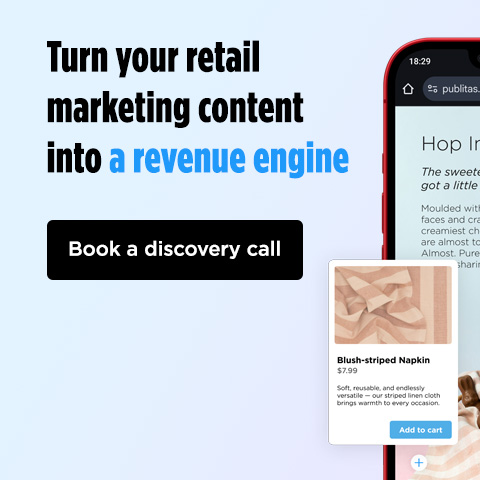
Static banners and PDF flyers ask shoppers to do all the cognitive work: see the offer, remember the product, click through, search again, find it, add to cart. Interactive shopping experiences collapse those steps. Shoppable digital catalogs, interactive lookbooks, and embedded shoppable videos let shoppers tap directly from inspiration to product page, removing friction that compounds during a season when attention is fragmented and competitors are one swipe away.
This matters most for gift discovery, where shoppers don’t always know what they want. A shoppable gift guide categorized by recipient or price range turns browsing itself into the conversion path. Interactive formats also generate behavioral signals that feed back into holiday promotional strategies mid-campaign. Also, Home Centre uses digital catalogs to guide shoppers through its summer collection with visually organized seasonal merchandising.
3. Optimize every campaign for mobile-first holiday shopping
Every campaign needs to be optimized, but mobile needs to be the first. Adobe’s 2025 data shows 56.4% of holiday transactions completed on smartphones, rising to 66.5% online sale on Christmas Day. Anything in the conversion path that breaks on a phone breaks the campaign.
Audit creative for mobile rendering, checkout flows for thumb-reachable buttons, and load times for cellular network performance. Cart abandonment data from Baymard Institute puts the average online shopping cart abandonment rate at around 70.22%, with documented checkout improvements capable of lifting conversion by up to 35.26%. Most of that opportunity sits on mobile.
4. Build campaigns around high-intent shopping moments
Not every day in Q4 is equal, and not every shopper is equally ready to buy. High-intent moments are concentrated around shipping cutoffs, payday cycles, themed shopping days (Green Monday, Free Shipping Day, Super Saturday), and category-specific drops. The most effective holiday retail marketing strategies build ecommerce holiday campaigns around these moments with offers, creative, and inventory positioning that reflect what the shopper is trying to accomplish on that specific day.
A late-November shopper comparing gift options needs gift guides and bundle recommendations. A December 18th shopper needs shipping guarantees and same-day pickup. Treating these as the same audience with the same messaging wastes media spend on both ends.
5. Segment campaigns by shopper intent, not broad audience assumptions
Demographic segmentation is too coarse for a season where the same person plays multiple shopping roles in three weeks. The more useful axis is intent including gift researcher, deal hunter, last-minute buyer, returning loyalist, lapsed customer being reactivated. Each one needs different creative, offer logic, and follow-up timing.
Behavioral segments based on browse and purchase history outperform demographic segments because they reflect what the shopper is actually doing right now. Use first-party data to build these segments, then layer in retargeting for shoppers who browsed but didn’t convert. The early-November researcher is often December’s highest-intent retargeting audience.
6. Use social proof to reduce purchase hesitation
Holiday shoppers face higher purchase stakes (it’s a gift, not a self-indulgence) and lower error tolerance (returns are inconvenient, deadlines are real). Social proof reduces hesitation including reviews on product pages, customer photos in shoppable catalogs, ratings and trust badges at checkout, and influencer content. For example, Capitol Lighting uses social media to showcase seasonal product collections, helping shoppers evaluate products through styled, real-world inspiration across channels.
The best holiday retail marketing strategies treat social proof as a built-in conversion layer, not a finishing touch. Build creator relationships and briefs in summer for content that runs in October and November.
7. Optimize campaign performance in real time
Q4 is too short and too expensive to wait for end-of-week reporting. Real-time optimization (monitoring engagement, conversion, and inventory signals daily or hourly during peak days) is the difference between a campaign that adapts and one that just runs. Build dashboards that track metrics that predict revenue including add-to-cart rate, page depth, bounce on key landing pages, and channel-level ROAS.
Have a “what-if” plan ready before Cyber Monday, which creative gets pulled if engagement drops, which audiences get reallocated budget if performance spikes, which offer tier activates if conversion lags. The brands that win Q4 have the fastest response loop.
Why interactive digital merchandising performs better during holiday campaigns
Interactive digital merchandising performs better during holiday retail campaigns because it solves a discovery problem static format can’t. Shoppers spend more time researching during the holidays (Salesforce reported a 35% YoY jump in time spent on U.S. retail sites), and that time is fragmented across mobile screens, social feeds, and email. Static creative makes shoppers connect inspiration to inventory themselves; interactive formats embed inventory directly into the inspiration.
A shoppable digital catalog organized by recipient (“gifts for him,” “gifts under $50,” “new arrivals for the holidays”) works as both a discovery surface and a conversion surface. Each tap on a product opens the product detail or adds to cart without leaving the catalog, reducing the drop-off between a banner ad and a category page. It also generates engagement data per product and per session that informs which items get amplified mid-campaign.
Retail teams running interactive digital catalogs often use platforms like Publitas to publish shoppable, mobile-optimized catalogs and lookbooks across owned channels and distribution partners. The format suits the multi-phase, mobile-first, intent-driven approach that defines effective holiday retail marketing strategies today.
Create higher-performing holiday shopping experiences
The brands that grow ecommerce conversion this holiday season won’t be the ones running the loudest promotions. They’ll be the ones whose campaigns reflect how shoppers actually behave now like starting earlier, researching longer, buying on phones, and trusting peer signals more than ad copy. Each of the seven holiday retail marketing strategies above maps to a specific behavior shift and a conversion lever you can pull this quarter.
Start with the phase you can execute well today (campaign timing, mobile optimization, or interactive formats) and use the results to fund deeper investment in the others. The compounding effect across a multi-month season is what separates a good Q4 from a record one.
Plan your next holiday campaign with interactive shopping experiences. Explore how interactive, mobile-optimized digital catalogs help retailers convert during peak season. Learn more about Publitas
Frequently asked questions
When should retailers start holiday marketing campaigns?
Campaign planning for holiday retail marketing should begin as early as June or July, with campaigns launching between early September and October to capture early shopper intent. Retailers that wait until Black Friday to activate campaigns risk missing consumers who have already researched products, compared prices, and made purchasing decisions.
What types of holiday retail content drive the most ecommerce conversions?
Shoppable, mobile-first content drives the highest holiday ecommerce conversions. Personalized gift guides, curated digital catalogs, short-form video, and creator-led content perform well because they support faster product discovery and reduce friction between browsing and purchase.
How do digital catalogs improve holiday retail campaign performance?
Digital catalogs combine discovery and conversion in one surface. Shoppers can browse curated gift selections, tap products to view detail, and add to cart without leaving the catalog. They also generate engagement data that lets marketing teams optimize mid-campaign rather than waiting for end-of-season reporting.
What is the biggest mistake retailers make during holiday ecommerce campaigns?
The biggest mistake retailers make during holiday ecommerce campaigns is underpreparing for demand spikes across inventory, website performance, and fulfillment logistics. When traffic surges and product availability falls short, conversion opportunities are lost regardless of campaign spend.
How can retailers improve product discovery during seasonal campaigns?
Retailers can improve product discovery during seasonal campaigns through AI-driven search, personalized merchandising, seasonal layouts, and targeted social campaigns. These holiday retail marketing strategies help shoppers find relevant products faster and reduce friction across mobile, ecommerce, and in-store experiences.