Share article
Most retail content stops at the moment a shopper feels informed, leaving them to find their own way to a product page. A Content to Commerce Strategy closes that gap by connecting useful content with relevant products and clear commercial actions at every stage of the customer journey.
Buying guides, lookbooks, and product stories only earn their budget when they lead somewhere. Without that connection, brands run two separate operations, one for inspiration and one for conversion.
What Is a Content to Commerce Strategy?
Content marketing attracts and educates an audience. Content commerce connects that content directly to products and purchase actions.
A content to commerce strategy is the framework that makes the connection deliberate rather than accidental, mapping how content should move a shopper from discovery to consideration to purchase.
This differs from treating content and commerce as separate workstreams with separate owners and metrics. A content to commerce framework defines which content supports which stage, which products to surface, and what action comes next.
The journey is simple: content sparks discovery, supports consideration, and, built correctly, leads into purchase.
Why Does Content to Commerce Matter?
Brands that manage content and commerce separately, rather than as content to commerce marketing, create a structural gap between the moment a shopper is inspired and the moment they can act on it.
A shopper who reads a buying guide, closes the tab, and searches for the product later is a shopper the brand may never recover.
Connecting content to commerce closes that gap in three ways:
- Product discovery: Relevant items reach shoppers while interest is highest.
- Trust: Information stays consistent from first touchpoint through checkout.
- Retention: Shoppers who find products through helpful content tend to return to it.
Baymard Institute usability testing found that sites with weak product discovery saw task abandonment rates of 67 to 90 percent, compared with 17 to 33 percent on sites with even modestly optimized discovery.
How to Build a Content to Commerce Strategy
A content to commerce roadmap runs through six stages: Understand, Create, Connect, Activate, Measure, and Optimize. Each stage links customer needs, content, products, and channels.
Understand Your Audience and Buying Journey
Before creating content, identify what customers need to know, what questions stall their decision, and where purchase intent is highest. Map the content customer journey across four stages: discovery, consideration, evaluation, and purchase, with retention as a fifth.
Each stage calls for a different kind of content. Discovery favors inspiration, consideration favors comparison, and evaluation favors proof, such as reviews or demonstrations.
Understanding the ecommerce customer journey at this level lets a brand place the right content at the right point on the path to purchase.
Create Content That Helps Customers Make Decisions
Buying guides, comparisons, demonstrations, reviews, user-generated content, and editorial storytelling all serve the same purpose: they educate, inspire, resolve objections, or build confidence. The format matters less than the job the content does at that stage.
Reviews and other product discovery content carry particular weight. Research from Northwestern University found that purchase likelihood for a product with five reviews is 270 percent higher than for one with none, more pronounced on higher-priced items.
This is the mechanism behind content to conversion: proof-driven content moves shoppers further than content built purely for engagement.
Connect Content to Relevant Products and Actions
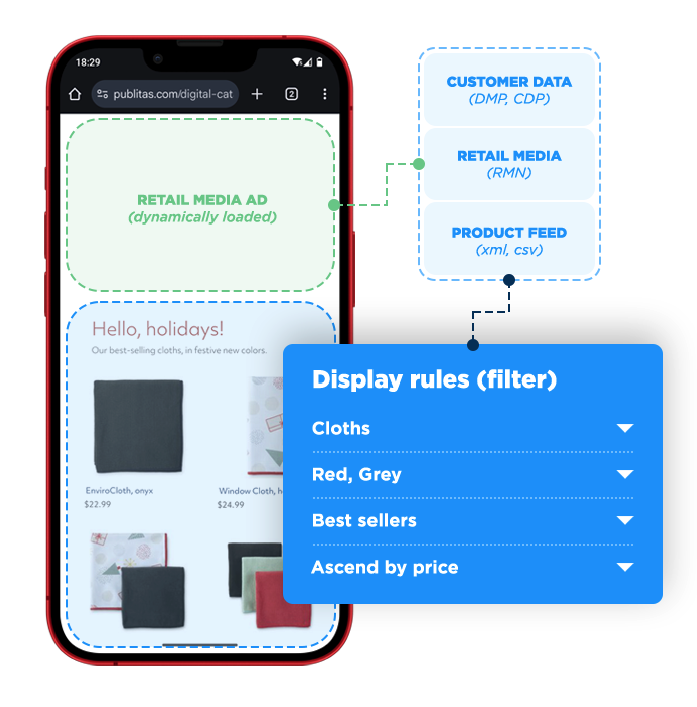
Content that informs but does not connect to a product or next step is a dead end. Contextual product links, recommendations, product cards, and product-rich pages give shoppers a direct route from interest to action.
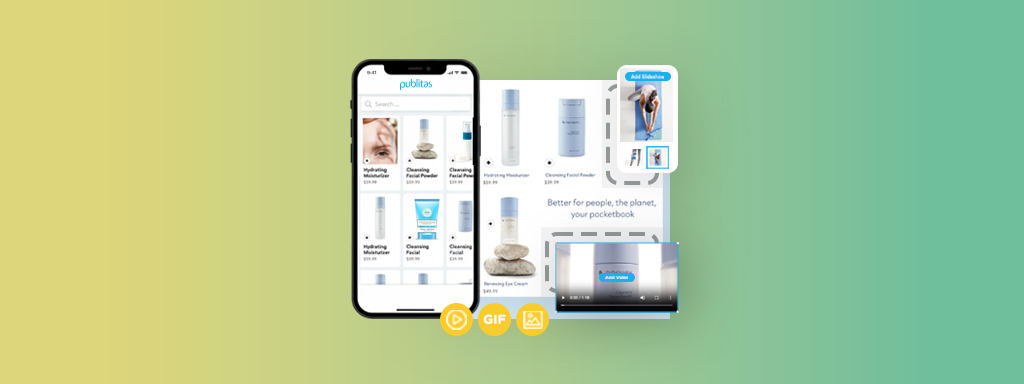
Digital catalogs and lookbooks serve this well, letting a shopper move from a curated collection into product detail without leaving the browsing experience.
Not every business runs a full add-to-cart flow: quote requests and consultation requests are equally valid depending on the purchase.
What matters for content to ecommerce integration is that a clear next step exists, visible at the moment interest peaks.
Personalize and Activate the Experience Across Channels
Customer context, such as past behavior or stated preferences, makes content and product recommendations more relevant.
Research shows personalized product recommendations typically lift revenue and raise marketing ROI 10 to 30 percent, with faster-growing companies drawing roughly 40 percent more revenue from personalization than slower-growing peers.
Personalization only produces value if it reaches shoppers where they are. An omnichannel content strategy distributes that content across search, owned websites, social, email, and digital catalogs. Consistency across channels matters more than volume.
Keep Content and Commerce Connected
Product prices, availability, and links need to stay accurate from the moment content is published through checkout. A broken link or an out-of-stock item presented as available does not just cost a sale, rather erodes the trust the content built.
Keeping content and product data synchronized is an operational requirement, not a one-time setup task.
Where Does Shoppable Content Fit Into the Strategy?
Content to commerce is the strategy. Shoppable content is one of the ways that strategy gets executed, giving shoppers a way to move from viewing a product to acting on it without leaving the content. Common formats include:
- Shoppable images: product tags let shoppers click directly from a photo into product detail.
- Video: product links surface at the moment an item appears in use.
- User-generated content: real customer photos and reviews carry purchase links alongside the credibility that drives conversion.
- Social content: product tags extend into feeds and stories, meeting shoppers where they already browse.
- Digital catalogs: curated collections connect directly to individual product pages.
- Lookbooks: full looks link to each product shown, letting shoppers buy an outfit piece by piece.
The format matters less than whether it serves the system already described. Shoppable content shortens the distance between interest and action, but it does not replace the strategic decisions that determine whether that distance leads to a sale.
How to Measure and Optimize Content to Commerce
Measurement should follow the same path shoppers take, from engagement through to retention:
- Engagement: product clicks and views show whether content is drawing attention in the first place.
- Product interaction: click-through rate shows whether that attention moves shoppers toward a product.
- Conversion: add-to-cart actions and conversion rate show whether interest turns into a purchase.
- Revenue: revenue attributed to the content that drove it shows direct commercial value.
- Retention: repeat visits and repeat purchases from content-driven shoppers show whether the relationship continues past the first sale.
Content commerce analytics built around this path makes clear whether content is moving shoppers toward a purchase. Content commerce metrics turn that into something a team can act on at each stage.
Content attribution is where most programs fall short, in three connected ways:
- Content-assisted conversions get undercounted when content contributes to a sale completed through a different channel or session.
- Content-assisted revenue often gets credited instead to whichever channel closed the sale.
- Content commerce ROI ends up distorted as a result: content that quietly moves shoppers toward a later purchase can look like it underperforms when judged only on direct clicks.
A detailed breakdown of digital catalog ROI covers how to build that kind of attribution model.
Together, these content analytics tell marketers which content contributes to commercial outcomes at each stage. Then it follows a simple loop: measure what is happening, learn what the data shows, and improve content, product connections, or channel mix accordingly.
Common Content to Commerce Strategy Mistakes
A handful of mistakes account for most underperforming programs.
- Creating content without customer intent. Content built around what the brand wants to say rarely converts.
- Making every interaction promotional. Pushing a sale in every sentence loses the trust that made the content effective.
- Connecting irrelevant products. Recommendations that ignore context train shoppers to ignore future suggestions.
- Treating every channel identically. A recommendation that works in email rarely translates to social.
- Letting product information go stale. Outdated pricing or availability breaks the trust content built.
- Measuring traffic without commercial context. Page views describe attention, not revenue.
A Simple Content to Commerce Framework
The full system reduces to six connected stages, and following them consistently is among the clearest content commerce best practices:
- Understand: Map what customers need at each stage of the buying journey.
- Create: Build content that educates, compares, or demonstrates, matched to that stage.
- Connect: Attach relevant products and a clear next action to every piece of content.
- Activate: Personalize and distribute that content across the channels shoppers use.
- Measure: Track engagement through to revenue and retention.
- Optimize: Use what the data shows to refine content and product connections.
Retailers that treat content to commerce as a connected system than a single campaign, are better positioned to turn content investment into measurable outcomes.
A content commerce marketing strategy built around these stages gives marketing and ecommerce teams a shared framework. Platforms like Publitas support this approach by keeping digital catalogs, product data, and distribution connected.
FAQs About Content to Commerce Strategy
Does Content to Commerce Replace Traditional Content Marketing?
No. It complements content marketing, adding clearer connections between existing awareness content and commercial experiences.
Can Content to Commerce Work Without a Full Ecommerce Website?
Yes. Inquiries, quote requests, WhatsApp conversations, and marketplace or third-party checkout can all serve as the commercial step content connects to.
What Technology Is Needed to Implement a Content to Commerce Strategy?
The stack depends on business complexity, but typically includes a content management system, structured product data, commerce functionality, and analytics. Simpler businesses can start with far less.
How Does Content to Commerce Affect SEO?
Connected experiences support discovery through useful content and clear links between informational and commercial pages. The content still has to satisfy search intent on its own terms.
What Types of Businesses Benefit Most From Content to Commerce?
Businesses where customers benefit from discovery before buying see the clearest gains, including fashion, home furnishings, electronics, and travel. B2B businesses with research-heavy purchases can build a content to commerce strategy around the same model.
Enjoyed this article?
Get the next one straight to your inbox.