
Share article
Choosing an online publishing platform is difficult when tools support different formats, analytics models, and conversion goals. For marketing and ecommerce leaders, the Best Online Publishing Platforms for 2026 therefore vary by use case:
- Publitas supports shoppable product catalogs.
- Flipsnack suits mixed marketing content.
- Issuu prioritizes reach.
- Foleon fits web-native reports.
- WordPress, Ghost, and Substack work best for text-first publishing.
Interactivity, analytics, and lead capture should determine the final shortlist. Let’s explore the leading platforms and assess where each one fits.
Best Online Publishing Platforms at a Glance
| Platform | Best for | Content type | Interactivity | Analytics | Lead capture | Starting price | Free plan |
| Publitas | Retail catalogs | Flipbook | Shoppable overlays | Catalog analytics | External forms | $31/month | 14-day trial |
| Flipsnack | Mixed collateral | Flipbook | Advanced | Built-in | Native forms | $16/month | Yes |
| Issuu | Public reach | Flipbook | Links, video | Tiered | Higher tier | $19/month | Yes |
| FlippingBook | Sales documents | Flipbook | Rich media | Built-in | Higher tier | $20/month | No |
| Foleon | Web reports | Web-native | Advanced | Section-level | Native forms | Custom quote | No |
| WordPress/Ghost/Substack | Text publishing | Text | Varies | Varies | Subscriptions | $4/$18/$0 | WordPress: Yes; Ghost(Pro): No; Substack: Yes |
| Yumpu | PDF magazines | Flipbook | Multimedia | GA integration | Not native | €14.95/month | Yes, includes ads |
| Publuu | Small teams | Flipbook | Rich media | Advanced tiers | Higher tier | $7/month | Free trial |
Pricing and features were checked in July 2026; verify them before purchase because plan structures change.
What Is an Online Publishing Platform? (And What It Isn’t)
An online publishing software helps you create, host, distribute, and track catalogs, brochures, magazines, and reports.
Unlike a design tool or file-sharing link, it provides hosting, reader data, and interactive features. It manages individual publications rather than an entire website.
There are two main types of digital publishing platforms:
- Text-first tools such as WordPress, Medium, Ghost, and Substack support articles and newsletters.
- Business-focused platforms support interactive catalogs, flipbooks, and other marketing content.
This guide focuses on the second group because it is more relevant when you need product discovery, shopper analytics, shoppable content, and scalable catalog workflows, while still covering text-first options for comparison.
Also Read: Flipbook Distribution: How to Turn Flipbooks Into a Scalable Marketing Channel
Free vs. Paid Publishing Platforms: What You Actually Give Up
Free plans work for testing, one-off documents, and low-risk internal use. Common restrictions include ads, platform branding, public sharing, limited analytics, and fewer security controls.
Paid plans provide stronger branding, custom domains, lead capture, analytics, and security. However, advanced capabilities may still require higher tiers.
The 7 Best Online Publishing Platforms in 2026
An interactive publishing platform depends on your content format, publishing workflow, and conversion goals. Retail catalogs, reports, sales documents, and newsletters each require different capabilities.
Here are the seven best online publishing platforms:
1. Publitas: best for shoppable product catalogs
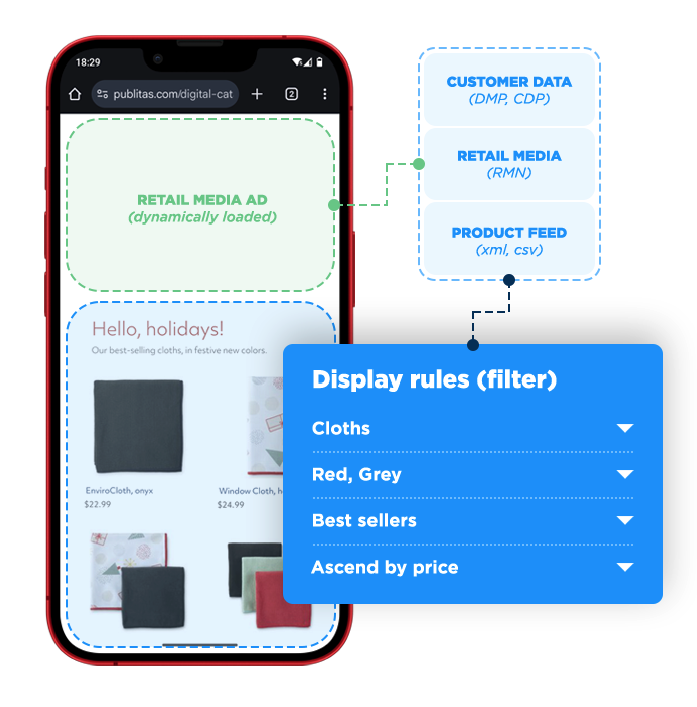
Publitas focuses on digital-first catalog publishing for retailers and ecommerce teams. Gold plans support product overlays, product-feed imports, product-detail synchronization, SKU detection, and scheduling, while Enterprise adds personalization and dynamic product, price, and availability capabilities.
- Best for: Retail teams turning catalogs into measurable product-discovery and shopping channels.
- Strengths: Product overlays, feed integration, custom branding, shoppable flows, GA4 integration, and enterprise catalog analytics.
- Limitations: Less suited to general marketing documents such as reports or presentations.
- Starting price: A 14-day free trial is available, after which plans start at $31 per month with annual billing.
2. Flipsnack: best all-round for mixed marketing content
Flipsnack creates, converts, publishes, and tracks catalogs, brochures, reports, and presentations through PDF conversion, templates, and a drag-and-drop editor.
- Best for: Marketing teams managing several content formats.
- Strengths: Broad content support, native design tools, lead capture, and page-level analytics.
- Limitations: SSO, product-data automation, API access, and advanced enterprise controls require the Enterprise plan.
- Starting price: $16 per month with annual billing.
3. Issuu: best for content discovery and reach
Issuu supports public flipbook publishing and content repurposing. Its paid tools can turn uploaded documents into articles, social posts, and GIFs, making it useful when your priority is extending distribution beyond the original PDF.
- Best for: Brands and publishers prioritizing public reach.
- Strengths: Public distribution, social-ready content, links, video, and website embedding.
- Limitations: Ads on free plan, public-by-default, no built-in editor, limited analytics on lower tiers.
- Starting price: $19 per month for Starter.
4. FlippingBook: best for sales enablement documents
FlippingBook converts finished PDFs into hosted and trackable sales documents. It supports branded links, analytics, access controls, and lead forms.
- Best for: Sales teams sharing trackable PDF-based documents.
- Strengths: Fast conversion, stable hosted links, access controls, lead capture, and engagement analytics.
- Limitations: No editor/templates, no e-commerce features, limited collaboration and integrations.
- Starting price: $20 per month with annual billing.
5. Foleon: best for web-native interactive reports
Foleon is a web-native publishing platform for responsive reports, whitepapers, magazines, and proposals. It provides interactive layouts, brand controls, analytics, and enterprise integrations without relying on a traditional flipbook format.
- Best for: Enterprise teams producing web-native reports and campaign content.
- Strengths: Strong design control, audience analytics, native integrations, reusable brand systems, and multi-team governance.
- Limitations: Steeper learning curve, not for catalogs/PDF workflows
- Starting price: Custom quote only.
6. WordPress / Ghost / Substack: best for text-first publishing
WordPress supports customizable websites, Ghost combines publishing with memberships, and Substack provides newsletter-first publishing with built-in discovery.
- Best for: Articles, editorial sites, memberships, and newsletters.
- Strengths: Strong content ownership options, flexible text publishing, subscriptions, and broad customization.
- Limitations: WordPress may require plugins and ongoing site management, while Substack charges a platform fee on paid subscriptions. None of the three is purpose-built for interactive retail catalogs.
- Starting price: WordPress offers a free plan to start; Ghost(Pro) starts at $15 per month annually; Substack is free to publish and charges 10% of paid transactions, plus payment-processing fees.
7. Yumpu / Publuu: lightweight PDF-to-flipbook options
Yumpu and Publuu convert PDFs into responsive digital flipbooks with links, media embeds, sharing, and basic analytics. They suit smaller teams and occasional publications that do not require advanced creation, commerce, or enterprise controls.
- Best for: Small teams, simple brochures, and one-off PDF publications.
- Strengths: Low entry cost, responsive flipbooks, media embeds, sharing, and basic analytics options.
- Limitations: Lead generation, product tags, custom branding, stronger analytics, and security controls require higher plans.
- Starting price: Yumpu offers a free plan to start. Publuu starts at $7 per month on annual billing.
Also Read: Flipsnack vs Issuu: Which Digital Publishing Platform Is Right for You?
How to Choose an Online Publishing Platform
Choose a platform that matches your content format, volume, measurement needs, and conversion goals. For retail teams, it should support product evaluation while keeping workflows measurable.
Here are the three criteria that should guide your decision:
1. Match the Platform to Your Content Type
Use PDF-based platforms for catalogs and brochures, web-native tools for reports, and text-first tools for articles and newsletters.
Product catalogs require clear navigation, accurate product details, and direct purchase paths.
2. Interactivity, Analytics & Lead Capture
Look for links, hotspots, product cards, videos, and forms that help shoppers move from browsing to evaluation.
Analytics should track opens, clicks, page activity, and drop-off points. Lead capture connects reader behavior with sales or marketing follow-up.
3. Branding, Hosting & Security
Check for custom domains, brand controls, stable links, password protection, SSO, and domain restrictions.
These capabilities protect brand consistency and gated content. Confirm which tier includes them before committing.
Do Interactive Publishing Platforms Actually Drive Revenue?
The best online publishing platforms can support revenue by connecting content with measurable shopper actions. Analytics, lead capture, and shoppable elements help move readers from discovery to purchase.
The main revenue mechanisms include:
- Analytics reveal high-interest pages and products.
- Drop-off data identifies weak points.
- Lead forms support follow-up.
- Product overlays reduce steps to purchase.
- A/B testing improves layouts and calls to action.
A flipbook alone does not generate revenue. Value depends on accurate product data, clear conversion paths, and consistent use of performance insights.
Migration & Lock-in: Switching Platforms Without Losing Your Content
Switching platforms can affect hosted links, analytics history, gated content, and SEO value. Assess portability before your content and reporting depend on one provider.
Key checks include:
- Export options for publications, leads, and analytics
- Hosted URL availability after cancellation
- Transfer of gated content and memberships
- Access to original PDFs and design files
- Custom-domain support
- Regular performance-data exports
These steps reduce vendor dependence and protect content continuity, reporting history, and public access.
Which Online Publishing Platform Should You Choose?
Your choice should reflect your content, intended reader action, and measurement needs.
- Choose Publitas for shoppable catalogs and product-feed integration.
- Choose Flipsnack for mixed marketing content.
- Choose Foleon for web-native reports and Issuu for public discovery.
- Choose FlippingBook for sales documents.
- Choose WordPress, Ghost, or Substack for articles and newsletters.
The best platform is the one that fits your workflow, reader journey, and performance goals, not the one with the longest feature list.
FAQs
What is the best free online publishing platform?
Flipsnack is a practical free option for testing PDF publishing. Its free plan includes platform branding, public visibility, restricted analytics, and fewer security controls.
What’s the difference between a publishing platform and a website builder?
A publishing platform distributes and tracks individual catalogs, magazines, and reports. A website builder creates and manages a complete website.
Which online publishing platform is best for product catalogs?
Choose a platform designed for shoppable catalogs. Look for product-feed imports, product overlays, shopping links, current product data, and product-level analytics.
Can I track how readers engage with my published content?
Yes. Built-in analytics can track opens, page views, time spent, clicks, and drop-off points. Lead-capture tools can connect activity with individual contacts, although reporting depth varies by plan.
Enjoyed this article?
Get the next one straight to your inbox.