
Share article
Every product page, search result, and homepage collection reflects a placement decision. Marketing and ecommerce teams often ask what digital merchandising actually involves, since the term gets applied inconsistently across teams.
In practice, it connects product data, shopper behavior, and campaign priorities into a coordinated system for what shoppers see, and when. This guide breaks down how it works, the functions it covers, and how to build a strategy around it.
What Is Digital Merchandising?
Digital merchandising is the practice of organizing, ranking, promoting, and personalizing products across digital shopping channels. It determines which products appear where, in what order, and under what conditions.
This digital merchandising definition applies across websites, mobile apps, search results, category and product pages, and email. A digital merchandiser or marketing team adjusts these touchpoints based on shopper behavior, product data, inventory levels, and business priorities like margin or seasonal timing.
The goal is straightforward: match the right products to the right shoppers at the right moment, without relying on guesswork.
How Is Digital Merchandising Different From Traditional Merchandising?
Traditional merchandising decisions were physical and largely static: a product sat on a shelf until someone moved it. Digital merchandising techniques apply the same commercial logic, but the methods shift entirely.
- Shelf placement becomes product ranking, adjustable in real time based on relevance and performance.
- Store displays become digital collections and curated grids.
- Salesperson recommendations become automated product recommendations, driven by behavior data.
- Physical signage becomes on-site promotions and dynamic banners.
The goal hasn’t changed: guide shoppers toward relevant products. What’s changed is the speed and precision available.
What Are the Core Functions of Digital Merchandising?
Digital merchandising covers four core functions, each responsible for a different part of how shoppers find and evaluate products. Understanding them separately makes it easier to diagnose problems and assign ownership.
They are: product placement and ranking, search and discovery, recommendations and personalization, and promotions and seasonal merchandising.
Product Placement and Ranking
Product placement and ranking determines where items appear on homepages, category pages, collections, and search result grids. Position matters: products near the top of a list get more views and clicks regardless of quality.
Ranking rules typically weigh several inputs together: relevance to the shopper’s query or context, historical sales performance, current availability, seasonality, and manual merchandising priorities such as promoting new arrivals or clearing aged inventory. Effective ranking balances these inputs rather than relying on one signal alone.
Search and Product Discovery
Search and product discovery, sometimes called searchandising, governs how shoppers locate products through the search bar and filters. This function includes search ranking, synonym handling, filter logic, and rules for surfacing in-stock items first.
Search is often the weakest link: Baymard Institute found that 70% of tested ecommerce search engines fail to return relevant results for product-type synonyms. Merchandising rules that account for synonyms and misspellings close this gap.
Recommendations and Personalization
Recommendations and personalization determine which products individual shoppers see, based on behavior, purchase history, and context. Common formats include recently viewed items, related products, complementary pairings, and personalized upsells.
Unlike placement and ranking, which apply to all shoppers on a page, recommendations vary shopper to shopper.
McKinsey research on digital merchandising strategy finds that personalization most often drives a 10 to 15 percent revenue lift, with company-specific results ranging from 5 to 25 percent. The lift comes from relevance, not volume.
Promotions and Seasonal Merchandising
Promotions and seasonal merchandising covers how products get temporary, elevated prominence around campaigns, seasonal collections, new launches, and discounts.
A back-to-school push or a holiday collection are both promotional merchandising decisions: existing placement and ranking rules get temporarily overridden to reflect timing and commercial priority.
Inventory plays a role too. Promoting a product that’s about to sell out creates a poor experience, so promotion rules typically check availability first.
How Does Digital Merchandising Work Across the Customer Journey?
Digital merchandising decisions compound across the customer journey. Understanding what digital merchandising does at each stage makes it easier to diagnose where a strategy falls short.
- Homepage: Surface entry points that match likely intent, seasonal priorities, and new arrivals.
- Category or collection page: Rank products by relevance and performance, while surfacing filters that narrow the assortment quickly.
- Search: Return relevant results even for imprecise queries, and recover gracefully from zero-result searches.
- Product page: Support the decision with accurate data, availability, and relevant cross-sell or upsell recommendations.
- Cart: Reduce friction and surface last-minute relevant additions without derailing checkout.
A digital merchandiser owns these decisions end to end, adjusting rules as inventory, campaigns, and shopper behavior shift.
What Does Digital Merchandising Look Like in Practice?
These digital merchandising examples show the functions above applied to specific situations.
A home goods retailer launching a fall collection creates a dedicated category page combining new arrivals with weather-appropriate bestsellers, ranked above older seasonal stock. This helps shoppers avoid scrolling through out-of-season inventory.
A specialty retailer improves search by mapping common misspellings and category synonyms, like “sneakers” and “trainers,” to the same results. This closes the gap between site terminology and shopper language.
An apparel brand shows “complete the outfit” recommendations on product pages, based on frequently purchased combinations. This helps shoppers who hadn’t considered complementary items.
Why Does Digital Merchandising Matter?
Digital merchandising matters because product discovery is still a common failure point in ecommerce.
Poor categorization and rigid rules push shoppers toward products that don’t match their intent, or bury ones that do. Research found that 75% of benchmarked ecommerce sites miscategorize products in ways that actively hurt product finding.
If done well, digital merchandising improves assortment relevance, makes better use of existing inventory, and gives campaigns a clear mechanism for visibility, with conversion and order value as likely downstream benefits.
Digital Merchandising vs. Visual Merchandising vs. Visual Commerce
These three terms overlap but aren’t interchangeable.
Digital merchandising manages product organization, placement, discovery, and commercial presentation across a site or app. It’s a systems-level discipline focused on what shoppers see and why.
Visual merchandising focuses specifically on how products and the storefront look: layout, imagery style, and visual hierarchy on category and product pages.
Visual commerce uses interactive content, such as photography, video, user-generated content, 3D, and AR, to help shoppers understand products. It supports digital merchandising rather than replacing it, since presentation still needs a placement strategy.
How to Build a Digital Merchandising Strategy
Building a digital merchandising strategy starts with a clear objective. A useful framework:
- Set the objective: Define the commercial goal.
- Understand shopper intent: Research behavior for the category or campaign.
- Define merchandising rules: Translate intent into placement, ranking, and promotion rules.
- Apply to touchpoints: Roll rules out across relevant pages.
- Test, measure, refine: Compare variations, track results, and adjust.
Each decision should trace back to a shopper need or a stated business objective, not whatever is easiest to automate.
What Tools Support Digital Merchandising?
Several tool categories support execution. Ecommerce platforms handle the product catalog and storefront. Searchandising tools improve on-site search relevance. Recommendation engines and personalization systems determine which digital product appears for which shopper.
Product information management (PIM) systems keep product data consistent across channels. Analytics platforms measure performance, and dedicated merchandising software applies ranking rules at scale. Most teams combine several of these rather than relying on one system.
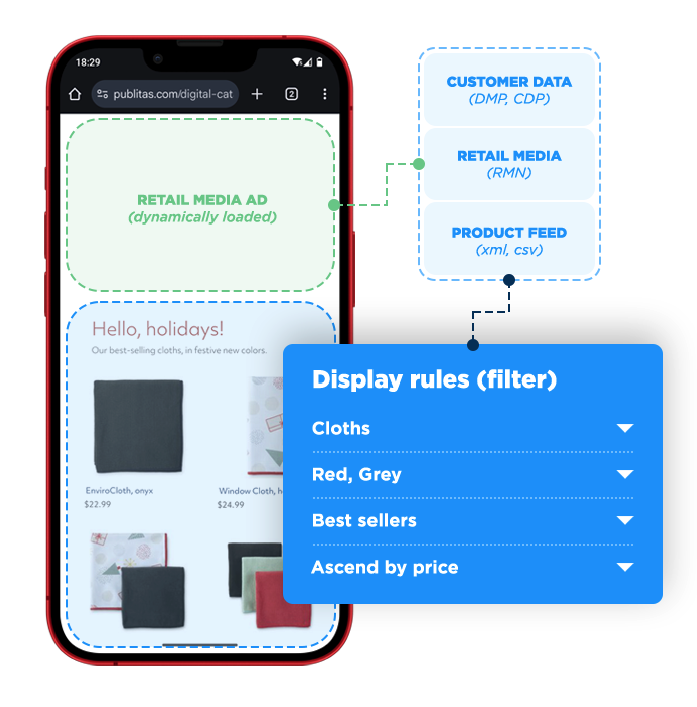
Platforms like Publitas support this work by connecting product data to shoppable digital experiences, giving teams a practical way to apply digital merchandising across campaigns.
How to Measure Digital Merchandising Performance
The right KPI depends on the merchandising objective, not a fixed scorecard.
- Product click-through rate: whether placement and ranking are generating engagement.
- Conversion rate and add-to-cart rate: whether shoppers act once they find a product.
- Average order value and revenue per visitor: whether recommendations and promotions are increasing basket size.
- Search conversion rate: whether search is returning results shoppers actually want.
- Product and category performance: which items and groupings are underperforming their placement.
A/B testing is the most reliable way to compare specific merchandising decisions, rather than relying on before-and-after comparisons that mix in seasonal changes.
How Is AI Changing Digital Merchandising?
AI increasingly shapes recommendations, product ranking, search relevance, and personalization, using behavioral analysis to automate merchandising decisions that once required manual rules.
It can detect patterns across large volumes of shopper data faster than a person could, adjusting rankings or recommendations in response.
The human role hasn’t disappeared. AI processes patterns and automates routine decisions, but merchandisers still set the commercial priorities behind those decisions and review the output to confirm it matches business goals and shopper intent.
FAQs About Digital Merchandising
Can Digital Merchandising Be Used for B2B Ecommerce?
Yes, B2B teams apply digital merchandising to complex catalogs, customer-specific pricing, and bulk purchasing, layering account-based rules on top of the same core placement and search functions.
How Often Should Ecommerce Merchandising Rules Be Updated?
There’s no universal schedule. Signals like inventory and pricing need continuous monitoring, while broader rules, such as seasonal priorities, are typically reviewed on a set cadence.
What Happens When Merchandising Priorities Conflict With Product Relevance?
This is a common tension. A high-margin product might get promotional placement, but merchandising shouldn’t push it toward shoppers whose intent clearly points elsewhere.
How Does Digital Merchandising Work With Multiple Product Variants?
Variant-level data, like size and color, needs to feed merchandising rules directly, so shoppers aren’t shown recommendations for combinations that are out of stock.
Who Usually Owns Digital Merchandising Within an Ecommerce Team?
Ownership varies by organization. It often sits within ecommerce or merchandising, but execution usually requires coordination across category management, content, and technology teams.
Enjoyed this article?
Get the next one straight to your inbox.