
Share article
Issuu vs Yumpu comes down to one practical question: do you need a polished content discovery network, or an affordable entry point for basic digital publishing?
Issuu offers a stronger paid experience with a public discovery network and social distribution tools built for publishers who want organic reach. Yumpu’s adFREE tier starts at €14.95/month and delivers unlimited uploads, ad-free reading, and custom branding at a lower cost than Issuu’s Starter plan.
For retail and ecommerce teams publishing product catalogs, neither platform is purpose-built for shoppable, commerce-driven content.
| Feature | Issuu | Yumpu |
| Free plan uploads | 5 publications (max 10 pages each) | 3 uploads |
| Free plan ads/branding | Issuu branding on all content | Yumpu ads and branding |
| Embedding on free plan | Not available | Available |
| Paid entry price | ~$19/month (Starter, billed annually) | €14.95/month (adFREE, billed annually) |
| Unlimited uploads | Starter plan and above | adFREE plan and above |
| Content discovery network | Yes, public editorial network | Google indexing; no editorial network |
| Custom branding | Starter plan and above | adFREE plan and above |
| G2 rating | 4.7/5 (111 reviews) | 3.5/5 (15 reviews) |
| Analytics depth | Full analytics at Unlimited ($188/mo) | Dashboard on paid tiers |
| Commerce/shoppable features | Basic shoppable links | Not available |
Verdict: Choose Issuu if content discovery and social distribution are core to your publishing strategy and you have the budget for a paid plan.
Choose Yumpu’s adFREE tier if you want unlimited uploads at a lower monthly cost and can work without a discovery network. If you publish retail catalogs with product feeds, neither platform covers the use case.
What Is Issuu?
Issuu launched in 2006 and has grown into one of the largest digital publishing platforms, with over 60 million publications and more than 100 million monthly visitors browsing its discovery network.
Its core use case is converting PDFs into polished, magazine-style flipbooks that can be shared, embedded, and distributed across social and email channels.
The platform serves content creators, publishers, marketing teams, and small businesses that need to present editorial content professionally, from real estate brochures and digital magazines to lookbooks and annual reports. The ability to repurpose a single publication into social stories, GIF banners, and mobile articles makes it a practical distribution tool for teams managing multi-channel output.
Issuu’s standout feature is its public discovery network. Publications are surfaced to readers browsing the platform by category and interest, giving publishers a built-in organic reach channel that most competitors do not offer.
What Is Yumpu?
Yumpu is a Swiss digital publishing platform (operated by i-Magazine AG) that converts PDFs into HTML5 flipbooks for online distribution. The platform serves small businesses, freelancers, and publishers managing recurring magazine output.
Its defining characteristic is accessible pricing: the adFREE plan at €14.95/month delivers unlimited uploads, ad-free reading, custom branding, and SEO backlinks for less than most competitors’ entry-level paid tiers.
Where Issuu leans into editorial discovery and content repurposing, Yumpu focuses on straightforward publishing and search visibility. Publications are indexed by Google and generate SEO backlinks from Yumpu’s domain on paid plans. The WEBKiosk plan (€69/month) adds a branded subdomain and drag-and-drop editor for organizations that need a more controlled, white-label presentation.
Issuu vs Yumpu: Feature-by-Feature Breakdown
Free Plan Comparison
This is the sharpest dividing line in the Issuu vs Yumpu comparison. Both free tiers exist, but neither supports serious professional publishing without upgrading.
Issuu’s free plan is the more restrictive of the two:
- Up to 5 publications, with a hard cap of 10 pages per publication.
- Issuu branding on all content, with no option to remove it.
- No embedding available on the free tier.
- Analytics limited to basic view counts.
A standard brochure or newsletter almost always exceeds 10 pages, which means the free tier functions primarily as a trial rather than a working publishing tool.
Yumpu’s free Basic plan is marginally more functional but carries its own tradeoffs:
- 3 uploads total.
- Yumpu ads and branding on all publications.
- Some reviewers have noted that the ad inventory on the free tier can include inappropriate content.
For testing the platform’s conversion quality, the free plan works. For client-facing content, it does not.
What this means for you: The real question from Issue vs Yumpu pricing is which paid entry-point fits your budget and use case.
Content Discovery & Distribution
Issuu’s content discovery network is a genuine differentiator. Publications appear in category feeds, and Issuu’s reader base creates passive discovery opportunities for publishers. The platform also auto-generates social assets from a single upload, covering:
- Instagram and Facebook stories.
- GIF banners for email campaigns.
- Mobile-optimized articles for broader distribution.
Yumpu offers Google indexing and SEO backlinks from its domain on paid tiers, which contributes to search visibility over time. There is no editorial discovery layer. Distribution on Yumpu is driven entirely by direct sharing, embedding, and organic search.
What this means for you: If organic content discovery matters to your distribution strategy, Issuu has a structural advantage Yumpu cannot match at any price tier.
Ads & Branding Control
Both platforms display platform branding on free content and require a paid plan to remove it. The specifics differ:
- Yumpu free plan: third-party ads and Yumpu branding on every publication; removed on the adFREE plan (€14.95/month).
- Issuu free plan: Issuu branding throughout the reading experience; removed on the Starter plan (~$19/month).
The cost difference between the two entry paid tiers is modest. But Yumpu adFREE includes unlimited uploads and API access, while Issuu Starter caps uploads and reserves full analytics for the $188/month tier.
What this means for you: For ad-free publishing at the lowest cost, Yumpu adFREE has a practical edge. For brand control paired with a discovery network, Issuu Starter is the more coherent package.
Embedding & Sharing
Yumpu includes embed functionality on its free plan, which gives it a practical advantage over Issuu at the zero-cost tier. Both platforms support direct URL sharing, social distribution, and website embedding on paid plans. Yumpu also includes QR codes from adFREE and above. Issuu offers stronger social asset repurposing tools, including auto-generated stories and GIFs, valuable for teams running active social campaigns.
What this means for you: Yumpu wins on embedding access at the free tier. Issuu wins on social content repurposing at paid tiers.
Analytics & SEO
Analytics access is heavily gated on both platforms. The key thresholds to know:
- Issuu Starter (~$19/month): 30-day performance statistics, basic engagement data.
- Issuu Unlimited ($188/month): full analytics, page-level data, lead gen, and conversion tracking.
- Yumpu paid tiers: analytics dashboards available, with depth increasing at higher plans.
Neither platform delivers enterprise-grade analytics at entry-level pricing.
On SEO, both platforms produce indexed, searchable flipbooks. Yumpu emphasizes domain-level SEO backlinks on paid plans. Issuu’s large site authority means publications can rank for relevant queries, particularly on the Unlimited plan where SEO tools are more fully developed.
What this means for you: Full analytics are expensive on Issuu. Yumpu’s SEO backlink model offers a practical, lower-cost path to search visibility.
Pricing Tiers
Issuu (billed annually):
- Free: 5 publications, 10-page limit per publication, Issuu branding.
- Starter: ~$19/month, increased uploads, branding removal, basic embedding.
- Unlimited: ~$188/month, full analytics, lead gen, digital sales.
- Teams: ~$417/month, multi-user access, SSO, admin controls.
Yumpu (EUR, billed annually):
- Free: 3 uploads, Yumpu ads and branding.
- adFREE: €14.95/month, unlimited uploads, ad-free, custom branding, SEO backlinks, API.
- WEBKiosk: €69/month, branded kiosk, subdomain, drag-and-drop editor.
- APPKiosk: €178/month, custom iOS/Android app.
- PROKiosk: €277/month, in-app purchases, subscriber management.
Non-EU users paying for Yumpu should account for currency conversion costs on top of listed EUR prices.
Pros and Cons of Issuu
Pros
- Public discovery network with over 100 million monthly platform visitors.
- Social content repurposing tools (stories, GIFs, articles) on paid plans.
- Clean, polished reading experience consistently praised across reviews.
- Integrations with Adobe InDesign, Canva, Google Drive, Mailchimp, and HubSpot.
- Content monetization via digital sales and subscriptions on the Unlimited plan.
Cons
- Free plan is effectively a preview, not a working solution.
- Full analytics and brand control gated behind the $188/month Unlimited tier.
- Customer support quality is a recurring complaint across G2, Capterra, and Trustpilot.
- Cancellation difficulties reported consistently across review platforms.
Pros and Cons of Yumpu
Pros
- adFREE plan delivers more features at a lower cost than Issuu’s Starter.
- Unlimited uploads from the adFREE tier.
- Embedding available on the free plan.
- Google indexing and SEO backlinks on paid plans.
- WEBKiosk plan offers a branded newsstand for publishers with recurring output.
Cons
- Free plan limited to 3 uploads with ads and platform branding.
- Ad quality on the free tier has been flagged as inconsistent by users.
- No editorial discovery network; distribution relies on direct sharing and search.
- Backend UI described as dated; limited product updates in recent years.
- Billing and cancellation complaints, particularly around annual auto-renewals.
What Do Real Users Say? Issuu vs Yumpu Reviews
On G2, Issuu holds a 4.7/5 rating from 111 reviews. Yumpu holds a 3.5/5 from 15 reviews. The difference in review volume matters: Issuu’s rating shows a broader, more statistically reliable user base.
Issuu users praise the reading experience, ease of publishing, and social distribution tools. The recurring criticisms are more operational:
- Significant pricing increases after the October 2024 plan restructuring, when Premium and Optimum merged into a single Unlimited tier.
- Customer support quality flagged across G2, Capterra, and Trustpilot, with reviewers describing difficulty reaching human agents.
- Cancellation difficulties reported across multiple review platforms.
Yumpu users highlight value for money on paid plans and ease of embedding as standout positives. The consistent criticisms centre on two areas:
- A dated backend interface that reviewers note has not evolved materially in recent years.
- Billing transparency issues, particularly around trial-to-paid transitions and annual auto-renewals.
Is There a Better Alternative to Issuu and Yumpu?
Both platforms were designed for editorial publishing: magazines, brochures, newsletters, and documents. For that use case, each delivers within the limitations described above.
For retail and ecommerce teams, the gap becomes apparent quickly. Neither Issuu nor Yumpu supports:
- Product feed integration or dynamic content.
- Shoppable overlays tied to live inventory.
- Ecommerce checkout within the publication.
- Analytics that track the path from content engagement to purchase.
A marketing director publishing a seasonal catalog on either platform gets a static flipbook with clickable links, not a connected shopping experience tied to live inventory.
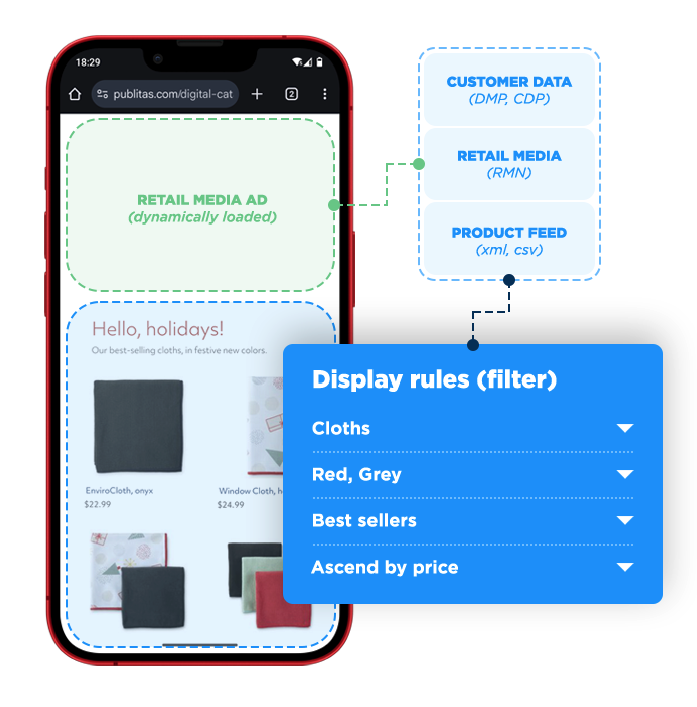
Platforms purpose-built for retail content, such as Publitas, operate differently. Rather than digitizing a PDF and hosting it, they connect catalog content to live product feeds, enable shoppable interactions within the publication, and integrate with ecommerce platforms to track conversion.
For teams managing high-frequency catalog publishing at scale, that capability difference matters.
The better alternative to Issuu and Yumpu for retail use is a platform that connects content to commerce infrastructure, not a general-purpose flipbook tool with basic link insertion.
How to Choose the Right Digital Publishing Platform
Four questions help clarify the decision:
- Do you need a free tier, or is a low-cost paid plan acceptable? Neither platform’s free plan is practical for professional content. Yumpu’s adFREE at €14.95/month is the lowest viable entry point across both platforms.
- Is organic content discovery important? If you want readers to find your publications without direct promotion, Issuu’s network provides a channel Yumpu does not. If you plan to drive traffic yourself through search, email, or social, Yumpu’s SEO tools and embedding are sufficient.
- Do you need ad-free, branded content from day one? Both platforms require a paid subscription to remove platform branding. Yumpu reaches that threshold at a lower price.
- Are you publishing editorial content or commerce content? For magazines, newsletters, and brochures, both platforms are reasonable options. For product catalogs or shoppable retail content, both fall short of what purpose-built retail publishing tools offer.
Frequently Asked Questions
Is Issuu or Yumpu better for a free flipbook maker?
Yumpu’s free Basic plan allows 3 uploads with ads and platform branding. Issuu’s free plan allows up to 5 publications but limits each to 10 pages and does not include embedding. Neither free tier is practical for ongoing professional publishing. Yumpu’s adFREE paid plan (€14.95/month) is the more usable entry point if budget is the primary constraint.
Does Yumpu put ads on free flipbooks?
Yes, Yumpu’s free Basic plan displays third-party ads and Yumpu branding on all publications. Ad content is served by third-party networks and is not controlled by the publisher. Ads are removed on the adFREE paid plan and all higher tiers.
Which platform has better content distribution, Issuu or Yumpu?
Issuu has a stronger distribution advantage. Its public discovery network reaches over 100 million monthly visitors and surfaces publications to readers browsing by category. Yumpu relies on Google indexing and SEO backlinks on paid tiers, which support search visibility but do not generate the same platform-side organic reach.
Is Issuu or Yumpu cheaper for paid plans?
Yumpu’s adFREE plan at €14.95/month (billed annually) is cheaper than Issuu’s Starter at approximately $19/month. However, Issuu’s Starter includes a cleaner branded experience and access to its discovery network. Full analytics on Issuu require the Unlimited plan at $188/month, which has no direct Yumpu equivalent at a comparable price. The answer depends on which features matter most.
Is there a better alternative to Issuu and Yumpu for retail catalogs?
Yes, both platforms are designed for editorial publishing and offer limited commerce functionality. Retail teams that need product feed integration, shoppable overlays, and ecommerce connectivity will find that general-purpose flipbook tools do not cover the use case. Purpose-built retail catalog platforms are designed specifically to connect digital publication content to live inventory and purchase flows.
Enjoyed this article?
Get the next one straight to your inbox.