
Share article
Meta Title: Best Catalog Management Software in 2026: PIM vs. Publishing
Meta Description: Looking for the best catalog management software? Compare PIM and catalog-publishing platforms, with pricing, strengths, and a buyer’s framework.
Search for best catalog management software and most results cover only half the category. Product information management (PIM) tools manage and govern product data behind the scenes.
Catalog-publishing tools turn that data into shoppable, customer-facing catalogs, the half most guides skip entirely.
The right pick depends on which problem needs solving, and most mid-to-enterprise retailers end up needing both, not one instead of the other.
Best Catalog Management Software at a Glance
| Tool | Category | Best for | Key strength | Starting price |
| Pimcore | PIM | Enterprise data | Data modeling | $9900/yr |
| Akeneo | PIM | Governed workflows | Approvals | Free / Quote-based |
| Salsify | PIM | Syndication | Retailer reach | Custom quote |
| Plytix | PIM | Small/mid teams | Ease of use | Free / $499/mo |
| Sales Layer | PIM | Fast onboarding | 6-week setup | Custom quote |
| Publitas | Publishing | Shoppable catalogs | Overlays, feed sync | $31/mo |
| Flipsnack | Publishing | Flipbook catalogs | Templates, speed | $35/mo |
Pricing and features were checked in July 2026; verify them before purchase because plan structures change.
Verdict: a PIM fixes messy data at the source; a publishing platform turns data into a catalog shoppers buy from.
What Is Catalog Management Software?
Catalog management software helps businesses create, organize, and distribute product catalogs while keeping product data accurate and consistent across every channel.
The term covers two distinct workflows that rarely live in the same tool: one manages the data behind a catalog, the other manages the experience a shopper actually sees.
Data Management vs. Catalog Publishing: The Two Halves of “Catalog Management”
The backend is the PIM layer: tools that model, enrich, and syndicate product data. The front end is the publishing layer: tools that turn data into a catalog a shopper browses and buys from.
Most guides to catalog management solutions cover only the backend. Clean data still has to convert a browser into a buyer.
Takeaway: A shortlist made only of PIM vendors solves half the problem.
PIM vs. Catalog Publishing: Which Do You Actually Need?
The right starting point depends on where the pain lives.
Messy product data or syndicating to a dozen marketplaces calls for product catalog management software like Akeneo or Salsify. A static PDF nobody engages with points to ecommerce catalog management software built for shoppable experiences instead.
Most mid-to-large retailers need both: a PIM as the source of truth, feeding a publishing platform customers shop from.
The Best Catalog Management Software in 2026
Each tool below is labeled by category, since a PIM and a publishing platform solve different problems even when both get called catalog management software.
Pimcore – Best for complex enterprise product data
Category: PIM
Pimcore is an open-source-rooted PIM and DAM built for complex data modeling at enterprise scale.
- Deep, reusable data-object modeling.
- Built-in versioning and workflow controls.
Limitation: Heavy implementation; the admin interface assumes technical resources.
Starting price: $9,900/year, also has an Enterprise edition with custom pricing.
Akeneo PIM – Best for governed data quality workflows
Category: PIM
Akeneo centers on attribute governance and approval workflows, validating product data before it reaches any channel.
- Structured approval and validation workflows.
- Strong multichannel output.
Limitation: Technical setup, with a learning curve for non-technical users.
Starting price: Free Community and Growth packages, Advanced and Premium packages for custom pricing.
Salsify – Best for multichannel syndication
Category: PIM/Syndication
Salsify combines PIM, DAM, and syndication to help brands publish consistent content across marketplaces and retail partners.
- Channel-ready syndication to major retailers.
- Content quality scoring and approvals.
Limitation: Enterprise-weight onboarding; heavy interface for smaller teams.
Starting price: Custom quote only.
Plytix – Best PIM for small and mid-size teams
Category: PIM
Plytix offers an approachable, spreadsheet-familiar PIM with direct channel pushes to platforms like Shopify.
- Fast setup, low learning curve.
- Direct ecommerce connectors.
Limitation: Less depth than enterprise PIMs for very large catalogs.
Starting price: Free Standard plan (1,000 SKUs); Pro from $499/month.
Sales Layer – Best for fast onboarding
Category: PIM
Sales Layer is a cloud PIM built for rapid setup and automated field mapping across sales channels.
- Roughly six-week implementation.
- Automated attribute mapping.
Limitation: Less governance depth than enterprise-grade PIMs.
Starting price: Custom-quoted, by seats and scope.
Publitas – Best for shoppable, customer-facing catalogs
Category: Publishing / content-to-commerce
Publitas is a content-to-commerce platform that turns print catalogs, flyers, and product feeds into interactive, shoppable catalogs: the customer-facing half of catalog management.
- Product-feed import with dynamic price and inventory updates.
- Shoppable overlays and engagement analytics on opens, clicks, and product views.
Limitation: A publishing layer, not a backend PIM; complex catalogs still need a PIM alongside it.
Best for: Teams that need a measurable sales channel, not just a published catalog.
Starting price: Bronze from around $31/month; Gold, the shoppable tier, roughly $429/month; Enterprise custom.
Flipsnack – Best for quick flipbook catalogs
Category: Publishing
Flipsnack is a drag-and-drop flipbook maker with templates and PDF-to-flipbook conversion, built for speed over ecommerce depth.
- Fast creation from templates.
- Built-in interactivity and analytics.
Limitation: Less product-feed and ecommerce depth than catalog-commerce specialists.
Starting price: Free plan (watermarked, capped); paid plans from $35/month.
Key Features to Look For in Catalog Management Software
The right checklist depends on whether the gap is in the data backend, the publishing front end, or both.
Product Data Modeling & Governance
Reusable attribute modeling, validation rules, and approval workflows sit on the PIM side. This prevents messy data, duplicate SKUs, and uncontrolled changes at scale.
Multichannel Syndication & Integrations
Pushing clean product data to webstores, marketplaces, and partners without manual reformatting, backed by ERP and CRM integrations, keeps a brand consistent everywhere customers look.
Customer-Facing Catalog Experience & Shoppability
Interactive, mobile-responsive catalogs, shoppable overlays, and add-to-cart paths sit on the publishing side. This is where browsing turns into buying: data quality alone does not convert a shopper.
Analytics & Performance Tracking
Product- and page-level engagement analytics answer a different question than “was it published.” PIMs track data operations; publishing tools track what shoppers actually do once a catalog is live.
How to Choose the Right Catalog Management Software
A few factors could narrow the shortlist:
- Catalog complexity: Thousands of SKUs point toward a governed PIM.
- Channel count: Owned channels differ from syndicating to twenty marketplaces.
- Priority: Data governance, or a customer-facing experience that converts.
- Team size: Enterprise PIMs assume technical staff; smaller teams often prefer a self-serve tool.
How PIM and Catalog Publishing Work Together
A PIM acts as the single source of truth: attributes, pricing, and availability live there and get validated before anything ships.
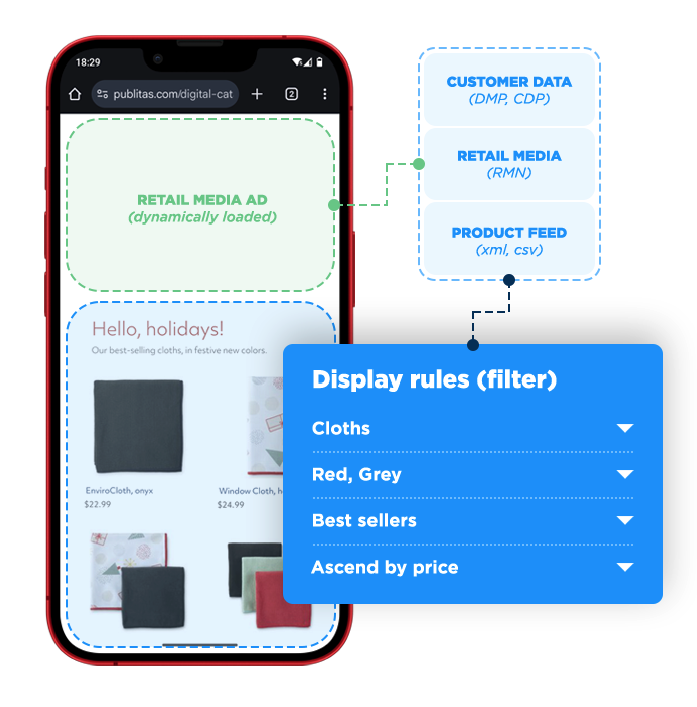
A publishing platform consumes that data through a feed and turns it into the catalog a shopper sees: enrich and approve in the PIM, publish an interactive catalog customers browse and buy from, then feed engagement data back.
A platform like Publitas sits at the front end, complementing a PIM’s governance rather than replacing it.
Does Catalog Software Actually Increase Sales?
Most vendors answer this with an efficiency story: better data, fewer errors, faster time-to-market. That is real, but indirect. PIM discipline lowers the cost of getting a catalog live; it does not make a shopper click “buy.”
The revenue case is stronger on the publishing side. Companies focused on customer engagement see cross-sell revenue rise 22%, upsell revenue 38%, and order size climb 5% to 85%, gains tied to engagement, not data cleanliness.
What holds up is the mechanism: shoppable links give a catalog a way to convert that a static PDF cannot. This is where a platform like Publitas becomes relevant: not a governance replacement, but the piece that turns a managed catalog into a measurable sales channel.
Frequently Asked Questions
What is the best catalog management software?
It depends on the job. For enterprise data governance, Pimcore, Akeneo, and Salsify lead. For an approachable PIM, Plytix fits best. For shoppable catalogs, shortlist from publishing platforms, not PIMs.
What’s the difference between a PIM and catalog management software?
A PIM governs product data as a single source of truth. Catalog management software is the broader term, covering both that data layer and the publishing layer that turns data into a customer-facing catalog.
Is catalog management software the same as a shoppable catalog tool?
No, a shoppable catalog tool is the publishing half of catalog management, built to let shoppers buy directly. Many tools labeled catalog management system software are backend PIMs focused entirely on data.
How much does catalog management software cost?
It varies widely. Lightweight PIMs and publishing tools can start under $50 a month, while enterprise PIMs run into the four to five figures annually. Confirm current pricing with each vendor.
Enjoyed this article?
Get the next one straight to your inbox.