
Share article
To build a business case for digital catalog software, you need to prove more than publishing efficiency.
Stakeholders want evidence the investment will improve revenue, reduce costs, and deliver returns. Most organizations treat catalogs as a production expense, not a commerce asset.
This framework helps justify digital catalog software investment with data leadership will approve.
Why Retailers Struggle to Justify Digital Catalog Software Investments
Most marketing and ecommerce leaders at enterprise retailers already know static PDFs and manual workflows are holding them back. The challenge is translating that frustration into financial terms that move a digital catalog business case forward.
Catalogs Are Often Viewed as a Cost Center Rather Than a Revenue Channel
- Leadership evaluates catalogs on design and distribution costs, not their contribution to product discovery, basket size, or conversion
- Marketing teams struggle to secure budget because catalog activity is tracked as a campaign expense, not a revenue driver
- Engagement data from catalog interactions such as product views, add-to-carts, and click-throughs rarely feeds back into performance reporting
- The commercial value catalogs generate goes unattributed, making future investment harder to defend
This is one of the most common reasons digital catalog business cases stall before reaching a decision-maker.
Existing PDF Workflows Hide Inefficiencies
- Merchandising teams rebuild product collections that already exist in your ecommerce platform or PIM
- Last-minute price changes require manual edits across multiple file versions, increasing error risk and delaying launches
- Promotional content cannot be easily reused across email, paid media, and ecommerce channels without rebuilding assets from scratch
- According to ProcessMaker research, employees in enterprise environments spend over 50% of their work time creating or updating documents such as PDFs and spreadsheets
These inefficiencies represent a measurable drag on productivity that does not appear on any single budget line.
Leadership Lacks Visibility into Customer Engagement Data
When your catalog lives as a static PDF, you lose the behavioral data that should inform product, merchandising, and campaign decisions. A catalog data dashboard makes every interaction trackable and actionable.
Without engagement analytics, you cannot answer:
- Which products generate the highest customer interest
- Where shoppers disengage before reaching a product page
- Which promotions drive product discovery vs. passive browsing
- How catalog engagement connects to downstream conversion
Marketing Teams Struggle to Prove Attribution and ROI
Research shows just 1 in 5 marketers are confident their attribution model accurately reflects campaign impact.
When catalog content cannot be tracked, it falls directly into that gap.
The 5 Components of a Strong Digital Catalog Software Business Case
A successful digital catalog business case connects technology investment directly to measurable business outcomes.
Define the Current-State Problem
Vague pain points do not move budget. Concrete operational problems do. Capture:
- Catalog production cycle length from briefing to publication
- Manual steps in each update or localization
- Approval bottlenecks and errors that reached publication
Executives fund solutions to problems, not software features.
Quantify the Cost of Maintaining the Status Quo
When the cost of doing nothing becomes visible, the conversation shifts. Estimate:
- Staff hours spent producing and distributing catalogs
- Agency costs for assets that could be automated
- Revenue impact from delayed campaign launches
- Localization overhead for regional teams
The longer inefficient processes remain, the larger the opportunity cost.
Define Expected Business Outcomes
Frame outcomes in business terms, not platform terms. If you are new to the format, understanding what a digital catalog can do helps ground these projections in realistic commercial outcomes. Key digital catalog software benefits to target:
- Reducing production cycles from weeks to days so campaigns launch when commercially relevant
- Increasing product discoverability through shoppable, searchable digital content experiences
- Improving engagement with personalized content based on location, language, or behavior
- Expanding content reuse across ecommerce, email, mobile, and retail media without rebuilding assets
- Supporting more campaigns without proportional headcount growth
Calculate Potential ROI
To estimate digital catalog software ROI, compare expected gains against total investment costs.
ROI = (Annual Benefits − Annual Costs) / Annual Costs x 100
Value drivers to model:
- Labor savings from catalog automation and reduced manual publishing
- Faster campaign deployment enabling real-time response to inventory changes
- Increased conversion from immediately shoppable content experiences
- Reduced agency spend through template-driven production
- Stronger marketing efficiency from continuous performance optimization
Align the Business Case to Stakeholder Priorities
| Stakeholder | Primary Concern | What to Emphasize |
| Marketing Leader | Campaign agility and performance | Faster launches, personalization, reach |
| Ecommerce Leader | Conversion and product discovery | Shoppable experiences, attribution |
| Finance Leader | Payback period and cost efficiency | ROI model, labor savings, risk |
| IT Leader | Integration and implementation risk | API flexibility, integrations, cloud |
The strongest digital catalog business cases address all four groups simultaneously.
Common Objections and How to Address Them
“Our PDFs Already Work Fine”
The question is not whether PDFs work. It is whether they deliver measurable commercial value. Consider what static formats cannot do:
- Track product-level engagement or customer behavior
- Update pricing or inventory without manual rework
- Support shoppable, personalized content experiences
“We Don’t Have Budget This Year”
Budget conversations focused on cost often stall. Cases focused on opportunity value move faster. Reframe the discussion around what inaction costs:
- Delayed campaign launches during peak seasons
- Lost conversion from unattributed catalog traffic
- Ongoing manual rework that consumes team capacity
“Implementation Will Take Too Long”
Evaluate time to value, not implementation duration. Modern cloud-based platforms typically deliver early wins within the first few campaign cycles:
- Faster production cycles before full rollout
- Measurable engagement improvements early on
“We Won’t Be Able to Prove ROI”
This is almost always a measurement problem, not a platform problem. The fix is straightforward:
- Capture baseline metrics before go-live
- Compare production time, engagement, and conversion at 90 days
What Success Looks Like After Implementation
Measuring outcomes starts before go-live, not after.
Establish Baseline Metrics Before Launch
Before deploying, capture:
- Average catalog production time from brief to publication
- Current engagement metrics: views, click-throughs, time on catalog
- Conversion rates for traffic originating from catalog content
- Campaign timelines and frequency of post-launch corrections
These create the baseline against which all future digital catalog software ROI claims are validated.
Monitor Early Adoption Metrics
In the first 30 to 60 days, watch for:
- User engagement and product interaction rates
- Click-through rates vs. previous catalog formats
- Content consumption patterns by product category
- Customer journey behavior from catalog entry to product page
Measure Business Impact at 90 Days
After three campaign cycles, evaluate:
- Production efficiency: hours saved and cycle time reduction
- Campaign deployment speed vs. prior baseline
- Revenue contribution from catalog-sourced traffic
- Conversion and engagement uplift across products and categories
These measurements validate digital catalog software ROI and build the case for future investment.
Next Steps: A 30-Day Plan to Build and Present Your Business Case
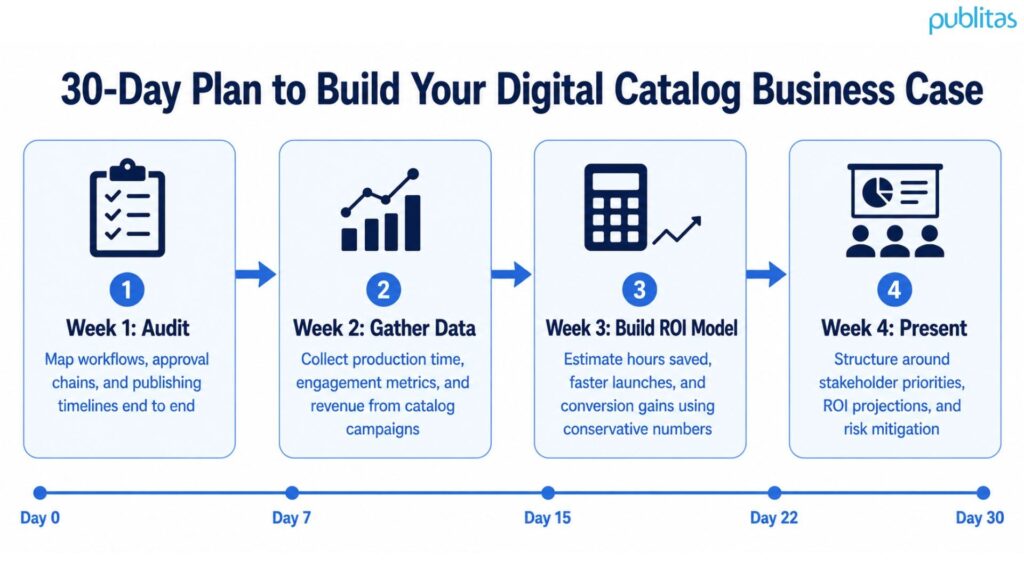
Week 1: Audit Current Catalog Processes
Document your current state:
- End-to-end workflows from briefing to publication
- Team responsibilities and approval chains
- Publishing timelines and recurring bottlenecks
Week 2: Gather Performance Data
Collect:
- Average production time per catalog
- Stakeholders involved per cycle and approval steps
- Frequency of post-launch manual updates
- Catalog engagement data: views, click-throughs, product interactions
- Revenue from catalog-driven campaigns
Strong business cases begin with strong data.
Week 3: Build ROI Assumptions
Estimate using conservative assumptions:
- Hours eliminated through automation
- Faster time-to-market for seasonal campaigns
- Revenue impact from improved product discoverability
- Incremental conversion gains from shoppable content
- Scalability benefits as campaign volume grows
Credible projections are more persuasive than optimistic ones.
Week 4: Present the Proposal
Structure your presentation around five anchors:
- Current-state challenges supported by data
- Business impact of the status quo
- Expected outcomes tied to each stakeholder group
- ROI projections with clearly stated assumptions
- Risk mitigation and implementation timeline
Publitas helps enterprise retailers move from static PDF workflows to dynamic, shoppable catalog experiences that can increase conversion rates by up to 3x and reduce design production time by up to 80%.
That makes the digital catalog software benefits significantly easier to quantify when presenting to leadership.
Conclusion
When you build a business case for digital catalog software, focus on outcomes, not features. A strong digital catalog business case quantifies inefficiencies, estimates gains, and aligns to stakeholder priorities. Done right, you can justify digital catalog software investment and prove digital catalog software ROI.
Ready to see what that looks like in practice? Book a demo with Publitas.
FAQs
How Do You Calculate ROI for Digital Catalog Software?
Calculate digital catalog software ROI using: (Annual Benefits − Annual Costs) / Annual Costs x 100. Benefits include labor savings from automation, faster campaign deployment, improved conversion rates from shoppable content, reduced agency spend, and incremental revenue from better product discovery.
What Metrics Should Be Included in a Digital Catalog Business Case?
Include catalog production costs, average campaign deployment time, engagement metrics (click-throughs, product interactions, time on catalog), conversion rates from catalog-sourced traffic, content reuse efficiency, localization overhead, and revenue contribution from catalog-driven campaigns.
Who Should Be Involved When Building a Business Case for Digital Catalog Software?
Marketing leaders, ecommerce and merchandising teams, content managers, finance stakeholders, and IT decision-makers should contribute. Aligning to all four perspectives improves approval rates significantly.
How Long Does It Take to See ROI from Digital Catalog Software?
Most teams see operational improvements within the first few months. Conversion improvement and broader commercial benefits typically become visible after several campaign cycles.
What Is the Biggest Mistake Retailers Make When Justifying Digital Catalog Software?
Focusing on platform features instead of business outcomes. Finance leaders and executives are evaluating revenue impact, operational efficiency, and risk. Your business case must speak that language from the first slide.
Enjoyed this article?
Get the next one straight to your inbox.