
Share article
Black Friday no longer means a single day of deep discounts, but a multi-week campaign spanning early promotions, a peak weekend, and the transition into the holiday season.
Effective Black Friday strategies for retailers usually treat it as one coordinated campaign built to grow revenue without eroding margin, inventory, or long-term customer value.
A record 202.9 million U.S. shoppers turned out over the Thanksgiving-to-Cyber-Monday stretch in 2025, underlining the scale retailers now manage in this window.
Start With Your Goals and Previous Black Friday Performance
Every Black Friday plan should start with explicit objectives for revenue, gross margin, customer acquisition, and retention. Without these, teams default to discounting as the only lever, which compresses margin without a clear return.
Reviewing last year’s performance narrows the plan. Pull data on:
- Product-level sales and inventory sell-through.
- Average order value and conversion rate.
- Marketing spend measured against profitability, not just revenue.
These figures show what to repeat, what to adjust, and what to retire. A promotion that drove traffic but suppressed margin needs a different mechanic this cycle, not a bigger discount.
Build a Phased Black Friday Campaign
Treating Black Friday as a single day limits its return. A phased campaign spreads demand, protects site performance, and gives shoppers more than one reason to engage.
A typical structure includes:
- Pre-Black Friday buildup, where retailers build email and social anticipation.
- Early access or teaser offers for loyalty members and subscribers.
- Black Friday and Cyber Monday as the peak selling window.
- A transition period that carries momentum into the wider holiday season.
Each phase should have its own goal, whether that is list growth, early revenue, or peak-day conversion. Among the most reliable Black Friday retail marketing tips is simply this: the campaign should build across phases, not repeat the same message for two weeks.
Build Value-Driven Offers That Protect Margin
Blanket discounts are the easiest promotion to plan and the hardest to profit from. Retailers looking at how to increase sales on Black Friday without giving up margin need offer variety, not just offer depth.
Differentiated and tiered discounts protect margin on core products while still creating urgency, and they scale down easily as Black Friday ideas for small businesses without the budget for storewide markdowns. Other mechanics worth building into the plan include:
- Bundles that combine complementary products at a blended margin.
- Gifts with purchase, which add perceived value without discounting the base price.
- Cashback or store credit offers that defer the cost and encourage a return visit.
- Exclusive or limited-run products not available at other times of year.
- Free-shipping thresholds that lift average order value while covering fulfillment cost.
The right discount mix depends on product margin, demand, and how valuable the customer is likely to be after Black Friday, not on matching a competitor’s headline discount.
Improve Product Discovery Through Strategic Merchandising
A crowded Black Friday storefront works against the retailer. Shoppers arrive with less patience and more competing tabs open, so product discovery has to do more work in less time.
Hero products, curated collections, and category-based discovery help shoppers find relevant items faster. Cross-selling and product recommendations extend that logic by surfacing related items at the moment of highest intent, rather than leaving discovery to search alone.
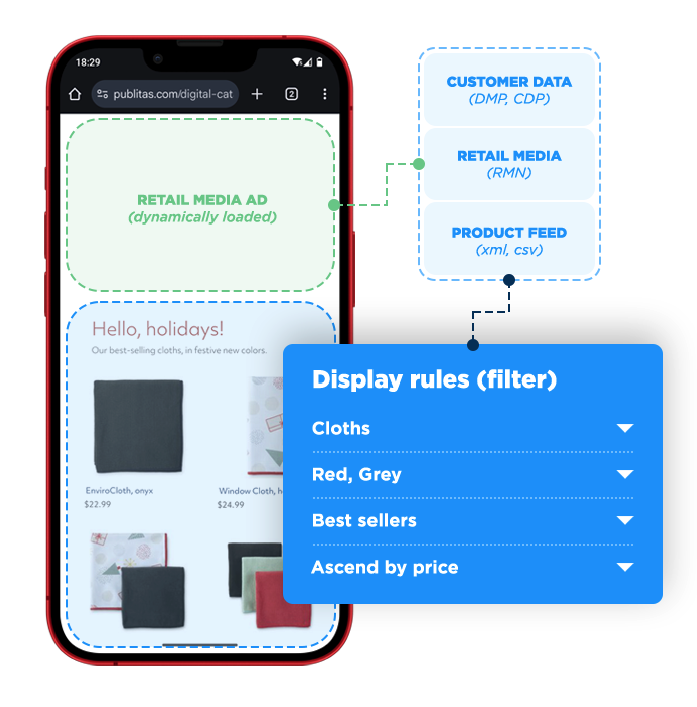
Digital and shoppable catalogs are one way to bring this structure together.
Platforms like Publitas lets retailers group Black Friday products into curated, interactive collections with direct links to purchase, rather than presenting a flat grid of discounted SKUs. That gives shoppers a guided path through a large assortment during the exact window when attention is scarcest and competition for it is highest.
Coordinate Marketing Across Retail Channels
Black Friday strategies for retailers only work if the offer shows up consistently everywhere a shopper looks for it. Website, email, SMS, social, paid media, physical stores, and marketplaces should all execute from one campaign strategy, even though each channel needs its own format and cadence.
Practical Black Friday retail marketing tips for coordination include:
- Locking core offers and timing before channel teams build individual assets.
- Adapting message length and visuals per channel rather than reusing one creative everywhere.
- Using a digital catalog as a shareable, trackable distribution format across email, social, and affiliate placements.
Treating channels as one campaign, not several isolated ones, keeps pricing and messaging consistent and makes it easier to see which channels actually drive revenue.
Personalize Offers by Customer Segment
Not every shopper should see the same Black Friday message. Purchase history, loyalty status, and engagement level all point to different offers and different levels of urgency.
VIP and loyalty segments respond well to early access, which rewards existing relationships before the broader push begins. First-time shoppers need a lower-friction, higher-clarity offer, while returning customers can be prompted with replenishment or upgrade offers tied to past purchases.
Personalization can lift revenue 5 to 15% and increase marketing ROI by 10 to 30%, with the fastest-growing retailers generating 40% more revenue from personalization than slower-growing peers.
Segmentation does not require a different campaign for every group, just a different entry point into the same one.
Prepare Ecommerce, Inventory, and Fulfillment
Optimize the Conversion Path
Traffic spikes expose weak points fast. Mobile experience, page speed, navigation, and checkout need to hold up under peak load, and payment options should match how shoppers want to pay, including buy-now-pay-later methods.
Checkout friction is costly even outside peak periods. The average cart abandonment rate is 70.22%, and fixing checkout usability issues alone can lift conversion by up to 35%.
Retailers should also have a contingency plan ready for traffic surges, stockouts, or payment processor issues before Black Friday, not during it.
Increase Average Order Value
Once the conversion path is solid, inventory and fulfillment planning determine whether demand turns into delivered, profitable orders. Accurate demand forecasting and clear shipping timelines reduce the risk of overselling or missed delivery windows.
Bundling products at checkout, rather than only as an upfront promotion, is a straightforward way to lift average order value without discounting further.
Build a Post-Black Friday Retention Strategy
A Black Friday purchase is only valuable long-term if it leads to a second one. Post-purchase communication should start within days, not weeks, while the purchase is still fresh.
Loyalty incentives, replenishment reminders, and cross-sell offers tied to what a customer just bought convert a one-time discount shopper into a repeat one. New and existing customers need different follow-up: the former need a reason to come back at full price, while the latter need recognition that they showed up again.
Measure Black Friday Success Beyond Revenue
Revenue alone hides whether a Black Friday campaign was actually profitable, and chasing it alone is a poor way to think about how to increase sales on Black Friday sustainably.
Retailers should judge campaign performance against gross margin, conversion rate, average order value, customer acquisition cost, inventory sell-through, return rate, and repeat purchase rate.
A campaign that grows revenue while margin, CAC, or return rate moves the wrong direction has not generated profitable growth, just higher transaction volume. Reviewing this full metric set, rather than the topline number alone, is what separates a repeatable strategy from a one-time spike.
Frequently Asked Questions
How can retailers prevent Black Friday sales from cannibalizing full-price purchases?
Discount select SKUs, bundles, or older inventory rather than applying storewide markdowns, and give loyalty members early access instead of discounting to everyone at once. This protects full-price sales in categories that don’t need a discount to move.
Should retailers create Black Friday-specific products or bundles?
Yes, in many cases. Exclusive bundles or limited-run products offer something new without discounting core inventory, and they make direct price comparison with competitors harder since the exact combination isn’t available elsewhere.
How can retailers manage demand if a Black Friday promotion significantly outperforms expectations?
Keep a contingency plan ready: safety stock on hero products, a waitlist or backorder option, and clear communication about restock timing. Setting expectations early protects customer trust even when a promotion sells out faster than planned.
How can retailers make Black Friday promotions feel credible to price-conscious shoppers?
Credibility comes from transparent pricing history and verifiable savings, not vague claims. A clear reference price and no inflated “original” prices help shoppers trust the offer instead of second-guessing it.
How should retailers coordinate Black Friday with Cyber Monday?
Treat them as one continuous window with different emphasis, not two separate events. Black Friday strategies for retailers often lead with doorbusters and in-store traffic, while Cyber Monday shifts focus to online-exclusive deals and tech categories.
Enjoyed this article?
Get the next one straight to your inbox.