
Share article
Today, eight types of visual content to attract customers work in 2026, and the right mix depends on your audience and goal. Below we cover each format, map it to the buyer journey, and show how to turn attention into sales.
Why Visual Content Attracts (and Converts) Customers
Visuals clear the attention barrier fast. MIT neuroscientists found the brain can identify an image seen for as little as 13 milliseconds, roughly the window a scrolling shopper gives your product photo.
Attention alone is not the goal, though. The formats worth investing in are those that carry a shopper from discovery to purchase, and Statista estimates 2026 social commerce revenue at $586 billion, while separate market research values live commerce at more than $200 billion. That is the bar these types of visual content now have to clear.
The Best Types of Visual Content to Attract Customers
Eight formats, each with the stage it serves.
Photography and Original Images
Original product and lifestyle photography still anchors visual content marketing. Authentic photos can outperform stock because shoppers may recognize a library image they have seen elsewhere. Best for product pages, social, blog visuals, and local search.
Tip: run a reverse-image check to confirm your shots are not on competitor sites.
Short-Form Vertical Video
Ten- to sixty-second 9:16 clips on TikTok, Reels, and Shorts are a dominant discovery format in 2026. Wistia’s 2026 State of Video Report, built on 13 million videos, found that clips under a minute average a 52% engagement rate, meaning viewers watch about half the runtime. Best for top-of-funnel discovery, product demos, and brand personality.
Tip: land the hook in the first two seconds.
Interactive Catalogs, Lookbooks, and Digital Magazines
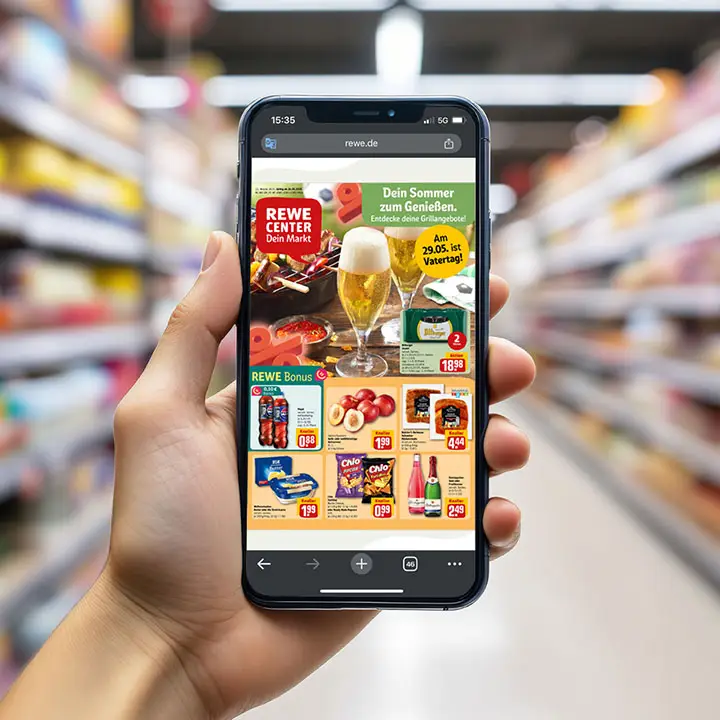
Interactive catalogs, lookbooks, and magazines turn static product content into browsable experiences with embedded video, links, and product tags. They bridge content and commerce, since a shopper moves from a styled page to a product without leaving the publication. Best for retail product discovery and brand storytelling.
Tip: unlike a flat PDF, these can be made shoppable and tracked page by page.
Infographics and Data Visualizations
Infographics condense complex information into shareable visuals, and an emerging edge is animated data visualization that reveals a trend as the reader scrolls. They earn links because publishers cite the graphic rather than rebuild the research. Best for education and backlinks.
Tip: templates remove the designer bottleneck. A retailer can turn its returns data into a “what shoppers actually keep” graphic competitors end up citing.
User-Generated Content (UGC)
Customer photos, reviews, and short clips are among the highest-trust formats here and are strong converters. Emplifi’s social media benchmarks found posts featuring UGC drove 10.38 times higher conversion rates than brand-made posts, alongside higher order values. Best for product pages, social proof, and paid social.
Tip: build a pipeline, not a campaign. Ask for photos after purchase, secure rights then, and feature the best in on-site galleries.
GIFs, Memes, and Animation
Lightweight, shareable visuals humanize a brand, with on-brand memes extending reach beyond your follower count. Best for social, email, and community.
Tip: match your brand voice. A looping GIF showing a product in three colorways beats a static hero image in email.
Interactive Content (Quizzes, Polls, Calculators)
Quizzes, polls, and calculators make the reader act rather than scroll, lifting time on page and giving you first-party data that a static page never captures. Published conversion multipliers are mostly vendor-commissioned, so benchmark your own pages. Best for lead generation and personalization.
Tip: a product-finder quiz doubles as lead capture and audience segmentation.
Presentations, Slides, and Webinars
Slide decks and webinars package expertise into skimmable, repurposable visual content examples that keep working after the live date. They suit considered purchases, where a buyer wants depth before a demo. Best for B2B, education, and mid-funnel nurture.
Tip: cut one webinar into six clips, an infographic, and a gated deck. One recording covers several types of visual content to attract customers at once.
Shoppable and Interactive Visual Content: Turning Attention Into Sales
The 2026 shift is that discovery media has become a point of sale, and this is where the types of visual content to attract customers stop being a reach exercise. Product tags, hotspots, and in-context checkout let a shopper see price, variants, and stock inside the content they are already browsing.
Three formats carry most of this: shoppable content built from images and UGC galleries, shoppable video and live shopping, and shoppable catalogs. They strip steps out of the path to purchase and make visual content measurable, so you can see which pages held attention and where shoppers dropped off.
Be honest about the limits: shoppability rescues nothing if the content is weak or the checkout is clumsy. Headline live-shopping conversion rates come largely from Chinese platforms, where the format is mature, and do not transfer cleanly to Western markets.
Platforms such as Publitas turn retail content into shoppable, trackable commerce experiences, but the content still has to earn the click.
How to Choose the Right Types of Visual Content for Your Brand
Start with your audience, because platform-native formats usually work better. A vertical clip built for Reels may not translate well as a horizontal crop on LinkedIn.
Then match format to funnel stage. Short-form video and photography attract, interactive content and UGC qualify, and shoppable catalogs and product video convert. A common mistake is over-investing at the attract end and leaving the convert end to a plain product page.
Third, be realistic about resources: video and infographics need skill or budget; UGC and templates do not.
Finally, ask whether the content needs to be measurable or shoppable, because that narrows your tooling immediately. A focused mix of three or four complementary formats is usually more manageable rather than a presence in every one, and our digital catalog design tips cover how to test the mix.
Your Next Step: From Choosing Types to Creating and Publishing Them
Each format has its own tool category. Canva and Adobe Express cover images and infographics, video editors handle clips, and UGC platforms curate customer content.
For catalogs and lookbooks, content-to-commerce platforms turn them into interactive, shoppable, trackable experiences, and we cover the wider set of PDF alternatives separately. The sequence matters more than the software: choose formats that fit your goals, create, publish, then double down on what converts.
Want to see what that looks like against your own product range? Try for free.
Common Visual Content Mistakes to Avoid
Leaning on generic stock is the first mistake, eroding the trust authentic imagery builds. Ignoring vertical formatting is the second, wasting most of the screen your audience is holding. Creating for attention with no CTA is the third, producing reach that never becomes revenue.
Inconsistent branding is the fourth, making your work harder to recall. Chasing every format is the fifth, spreading a small team thin and leaving each channel underserved. Not measuring performance is the sixth, since without data you repeat whatever failed.
Publishing static content where shoppable would convert better is the seventh, leaving money on a page that earned the visit. Over-producing UGC until it looks studio-made is the eighth, destroying the authenticity that made it work.
Frequently Asked Questions
What Type of Visual Content Gets the Most Engagement?
Short-form vertical video and user-generated content often lead engagement, with interactive formats such as quizzes and polls close behind. Videos under a minute hold viewers’ attention for about half their runtime. The strongest format depends on your platform and audience.
What Visual Content Converts Best for E-Commerce?
Shoppable content can shorten the path to conversion: shoppable images and UGC galleries, shoppable or live video, and shoppable catalogs. UGC and product video on product pages also convert well, since all of these shorten the path from discovery to purchase.
How Much Visual Content Should I Create?
Focus on a sustainable mix of three or four formats aligned to your goals rather than chasing volume. A steady weekly cadence in two formats is more sustainable than a scattered presence in eight.
Do I Need Expensive Tools to Create Visual Content?
No. UGC, short-form video, and template-based images and infographics can all be produced with free or low-cost tools. Among the best visual content for marketing, the types of visual content to attract customers that need a real budget are the shoppable ones, where you need product tagging or page-level analytics.
Enjoyed this article?
Get the next one straight to your inbox.